GIZUMO JAPANESE OCCULT · FOLKLORE & PERFORMANCE
Yamauba: When a Performer Meets Her Subject
Noh’s mountain woman confronts the performer famous for portraying her, opening questions about authority, movement, and the limits of a monstrous label.
Existing subject: Yōkai · Narrative: fiction · Spoilers: plot-spoilers
Content note: Discussion of a supernatural mountain figure and unsettling transformation in a traditional play.
The Japanese noh play Yamauba, also romanized Yamanba, considered as one theatrical treatment rather than a universal account of mountain-woman traditions.
The subject answers back
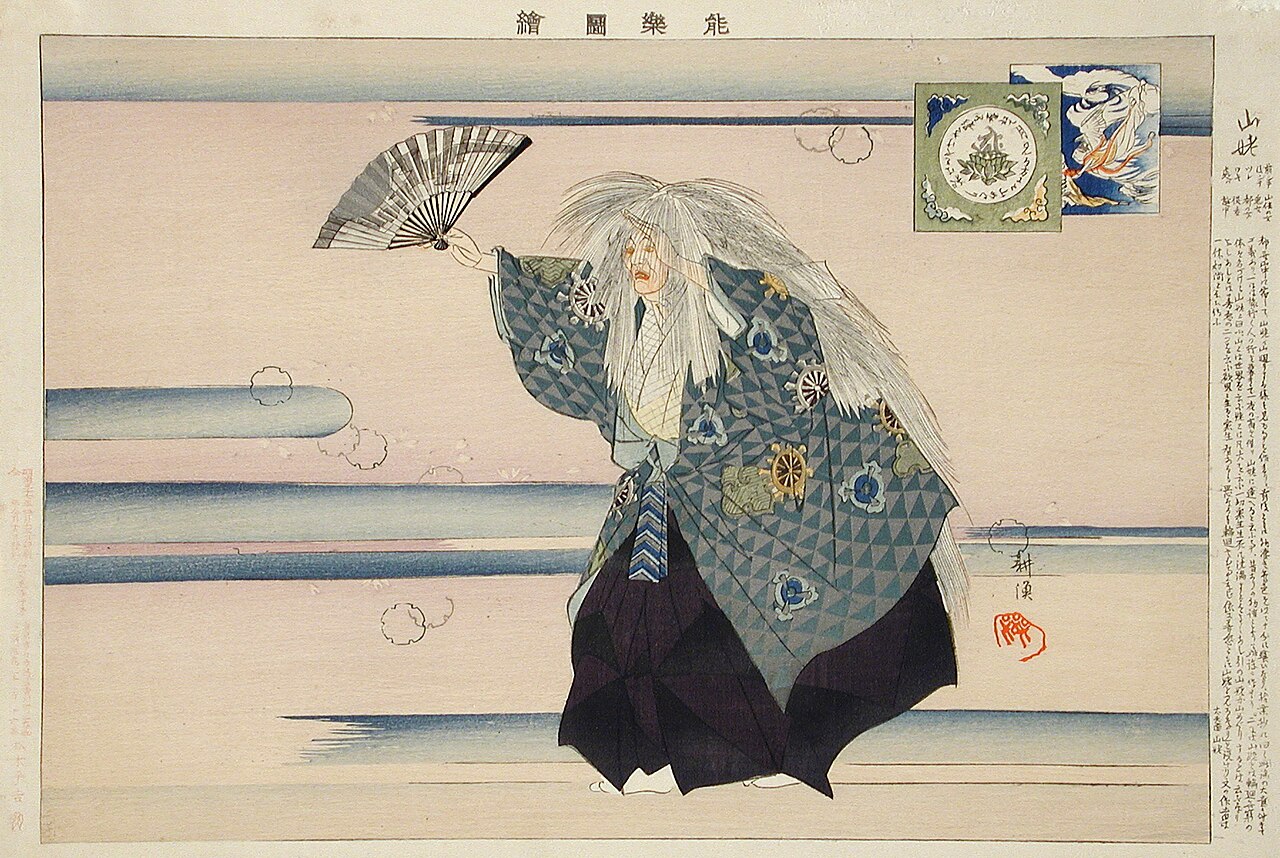
The noh play Yamauba, also encountered as Yamanba, puts an artist in an unexpectedly exposed position. According to the Nohgaku Performers’ Association, a woman celebrated in the capital for performing the mountain woman’s roaming encounters the actual subject of her performance within the drama. On the way to Zenkōji, she receives lodging from a mysterious woman who turns out to be Yamauba herself and teaches her about that mountain wandering. [YA1]
The encounter suggests a productive reversal of authority. In this reading, familiarity with a successful performance does not amount to complete knowledge of the person represented. The celebrated interpreter becomes a learner. Rather than treating the supernatural visitor only as a threat, the play makes her someone with a claim on how she is depicted. For spectators, the useful question is not simply whether the traveler will escape. It is what she must learn to see when her familiar artistic subject begins speaking back. [YA1]
Roaming beyond the performer’s control
The National Noh Theatre’s account describes an exchange: the traveler will demonstrate her art, and Yamauba will reveal her own form and dance. In the concluding movement, the mountain woman connects the workings of nature with Buddhist principles while singing and dancing her passage from mountain to mountain. Her disappearance concludes that theatrical encounter. These are features of the play’s imaginative world, not reports of a documented mountain being. [YA2]
I read the exchange as making imitation answerable to something it cannot entirely contain. The traveler’s established performance can present mountain roaming; Yamauba’s response insists that the experience exceeds that presentation. The difference is especially suggestive in dance, where knowledge arrives through movement as well as explanation. Her departure leaves the artist with an encounter to remember, rather than a permanently available subject. A viewer might ask whether the ending feels like instruction completed or like the beginning of a harder artistic responsibility. [YA2]
A mask is evidence of theatre
The National Noh Theatre’s 2024 exhibition catalogue lists two Yamanba masks from the Hōshō collection: one dated to the fifteenth century and another to the seventeenth. Its English descriptions call the figure a female mountain demon. The catalogue documents material objects and their institutional classification. It gives us evidence for the transmission of a theatrical image, while the dramatic exchange supplies a much less easily compressed personality. [YA3]
That difference between label and encounter is worth preserving. A short museum description helps identify an object, but it cannot perform all the work of a character speaking, teaching, and moving before an audience. My interpretation is that the play repeatedly makes confident naming insufficient: the traveler already knows the name that made her famous, yet still has something fundamental to learn. Approaching Yamauba as a particular dramatic relationship, rather than a specimen with fixed supernatural properties, allows her unsettling authority to remain active. [YA3]
Sources and original texts
Original cultural readings of folklore, fiction and artistic representations. Interpretations are distinguished from source descriptions. Access to a collection record does not grant permission to reproduce its images or text. No supernatural event is verified.
- Yamanba: repertoire entry — The Nohgaku Performers’ Association. Checked 2026-10-15.
- National Noh Theatre July 2026 performances: Yamanba — Japan Arts Council / National Noh Theatre. Checked 2026-10-15.
- National Noh Theatre Special Exhibition 2024: English catalogue, entries 35–36 — Japan Arts Council / National Noh Theatre. Checked 2026-10-15.
Original English cultural analysis. Institutional source descriptions are paraphrased, and interpretive conclusions are identified as readings. No source prose is reproduced. One image (Tsukioka Kōgyo's Noh illustration of Yamauba) is reproduced from Wikimedia Commons in the public domain and credited with the image.