GIZUMO JAPANESE OCCULT · FOLKLORE & PERFORMANCE
Hyakki Yagyō: How a Procession Changes the Way We Look
A cultural reading of the night parade as movement, sequence, and a risky act of looking, grounded in Japanese museum and library collections.
Existing subject: Yōkai · Narrative: folklore · Spoilers: none
Content note: Discusses historical beliefs about supernatural danger and death; no graphic detail.
Japanese night-parade traditions and surviving picture-scroll formats, with attention to Edo-period copies rather than a single definitive legend.
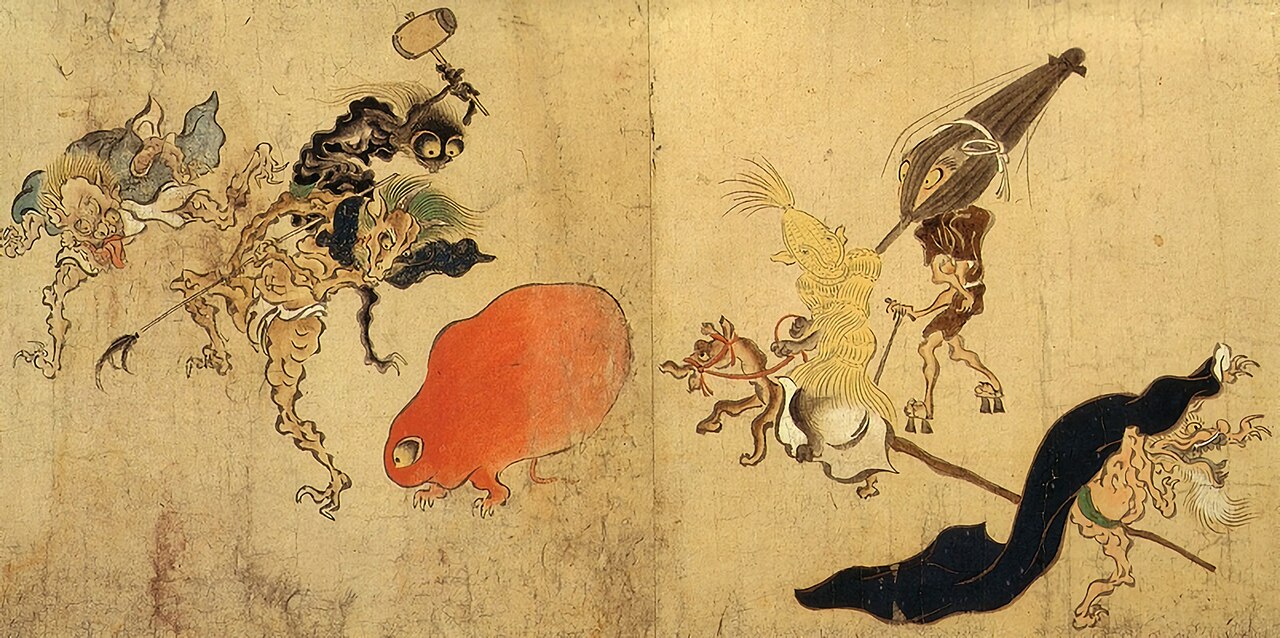
A crowd before a cast of characters
The National Diet Library describes its Hyakki yagyō emaki as a nocturnal procession through Kyoto. That basic arrangement deserves attention before any creature receives a name. A solitary apparition asks what has appeared; a procession also asks what is coming next. This essay reads the parade as a structure for sustained looking: each arrival renews curiosity while withholding the satisfaction of a final, complete view. The supernatural becomes an event with duration, rather than a specimen available at a glance. [HY1]
Such a reading does not require us to reconstruct an encounter as historical fact. The library identifies a picture scroll and a traditional subject, not evidence that monsters occupied Kyoto. Its useful distinction is between the represented city and the experience of the picture. A street gives unlike beings a shared route. The viewer can follow that route without needing to believe that every participant belongs to a single, internally consistent supernatural system. [HY1]
What ninety-nine tells us about a hundred
A Hyōgo Prefectural Museum of History example contains ninety-nine monsters. The museum describes figures extending from right to left and dates the work provisionally as a later Edo-period reproduction. Its catalogue therefore gives us a helpful resistance to overconfidence: a work called a parade of one hundred demons need not supply exactly one hundred, and a surviving scroll need not be the first version of its subject. Both counting and chronology deserve checking against the particular object. [HY2]
In this essay’s interpretation, the near-hundred is less interesting as a missing item than as a viewing problem. Counting encourages us to separate bodies, while the procession encourages us to connect them. Those two activities compete. We move between noticing individual differences and sensing collective motion. The museum’s directional description makes this tension concrete: the page offers many distinct forms, but their arrangement makes them seem to proceed together. A catalogue list can preserve names while losing that momentum. [HY2]
The pleasure of seeing what should be avoided
Japan Search’s historical overview records traditions in which witnessing the parade was fatal. It also notes humorous procession scrolls produced around the sixteenth century and explains the sunrise appearing in many examples through the belief that the beings vanished at dawn. These are reported cultural beliefs, with variation across sources, rather than warnings for present-day readers. Importantly, the overview places danger and amusement within the same broad subject. Neither tone cancels the other. [HY3]
Our interpretive conclusion is that the scroll creates a protected kind of spectatorship. The subject supplies a reason to look away, while the artwork rewards continued attention. Sunrise can also function, compositionally, as a limit on accumulation: an ending to the crowd and to the act of following it. To read a night parade well, ask how its sequence regulates anticipation and release. The most revealing question may be what the procession makes looking feel like. [HY3]
Sources and original texts
Original cultural readings of folklore, fiction and artistic representations. Interpretations are distinguished from source descriptions. Access to a collection record does not grant permission to reproduce its images or text. No supernatural event is verified.
- Hyakki yagyo emaki (Night parade of the demon horde) — National Diet Library. Checked 2026-10-15.
- Hyakki Yagyo Emaki — Hyōgo Prefectural Museum of History. Checked 2026-10-15.
- Hyakkiyako (Hundred Demon Night Parade) — Japan Search / National Diet Library. Checked 2026-10-15.
Original English cultural analysis. Institutional source descriptions are paraphrased, and interpretive conclusions are identified as readings. No source prose is reproduced. One image (a section of the Hyakki Yagyō picture scroll) is reproduced from Wikimedia Commons in the public domain and credited with the image.