GIZUMO JAPANESE OCCULT · FOLKLORE & PERFORMANCE
Tanuki: Shapeshifting as a Problem of Recognition
Three museum objects show how the tanuki’s transformations make viewers question appearances, disguises, and the relationship between an image and its use.
Existing subject: Yōkai · Narrative: folklore · Spoilers: none
Content note: Includes playful religious disguise; no graphic content.
Japanese tanuki imagery in early-seventeenth-century ceramics, Edo-period netsuke, and late-nineteenth-century painting; interpretations remain specific to these objects.
A creature that unsettles its own label
Kawanabe Kyōsai’s Tanuki Viewing Its Reflection in Water offers a useful complication before interpretation begins. The Metropolitan Museum of Art explains that the creature was traditionally identified as a fox; its face and tail instead suggest a tanuki, the Japanese raccoon dog. The museum connects the animal’s suspended movement and ambiguous reflection with its legendary transformations. Identification is therefore part of the work’s documented reception, rather than a neutral label we can simply pass over. [TA1]
This essay’s reading starts with that uncertainty. A viewer who mistakes one celebrated shapeshifter for another has already experienced a small failure of recognition. The reflection introduces a second problem: seeing an image does not automatically settle what produced it. We need not claim that Kyōsai planned the later cataloguing dispute. The more defensible observation is that the painting’s subject and its reception both make confident naming difficult. The tanuki’s instability reaches beyond the represented creature into the viewer’s judgement. [TA1]
The disguise that lets us see through it
The Met’s wooden netsuke Tanuki in a Lotus Leaf is attributed to Matsuda Sukenaga. Its short catalogue description identifies the leaf as a priestly disguise. Here transformation is presented through an intelligible costume: the viewer is told both what the creature is and what it pretends to be. We should keep that object-specific reading separate from any blanket assertion that all tanuki images mock Buddhism or that every clerical disguise carries the same moral accusation. [TA2]
In our interpretation, the pleasure lies in unequal knowledge. A disguise inside a story might fool another character, yet a carving titled as a tanuki invites its owner to recognize the trick. The creature succeeds as an image precisely because its pretence remains readable. This creates a compact theatre of appearance, with animal, costume, and spectator all participating. The religious reference supplies a recognizable social role, but the object alone does not establish a particular historical target for its humour. [TA2]
When the shapeshifter becomes a useful object
An early-seventeenth-century water-dropper at the Met takes the form of a raccoon dog. Made in the E-Shino ceramic tradition, it can also serve as a kettle-lid rest. The museum places its playful subject within the world of tea. The object thus brings transformation close to ordinary handling: one crafted form carries an animal identity while fulfilling more than one practical purpose. That material versatility is documented; any connection to the folklore remains an interpretation. [TA3]
Read alongside the painting and netsuke, the water-dropper suggests that tanuki imagery is especially rewarding when we examine how representation works. An uncertain likeness, a transparent disguise, and a multifunctional vessel each organize recognition differently. These examples cannot summarize every regional story. They do show why listing magical abilities is insufficient cultural analysis. Ask who recognizes the tanuki, what clues permit recognition, and whether the object invites looking, handling, or both. Its transformations can structure an encounter with art itself. [TA3]
Sources and original texts
Original cultural readings of folklore, fiction and artistic representations. Interpretations are distinguished from source descriptions. Access to a collection record does not grant permission to reproduce its images or text. No supernatural event is verified.
- Tanuki (Racoon Dog) Viewing Its Reflection in Water — The Metropolitan Museum of Art. Checked 2026-10-15.
- Tanuki in a Lotus Leaf — The Metropolitan Museum of Art. Checked 2026-10-15.
- Water-Dropper (Suiteki) in Raccoon Dog Shape — The Metropolitan Museum of Art. Checked 2026-10-15.
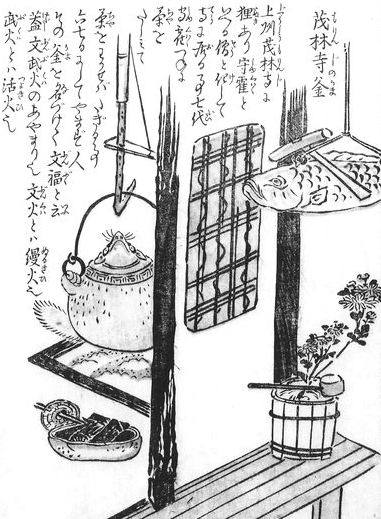
Original English cultural analysis. Institutional source descriptions are paraphrased, and interpretive conclusions are identified as readings. No source prose is reproduced. One image (Toriyama Sekien's Morinji-no-kama, the tanuki tea kettle) is reproduced from Wikimedia Commons in the public domain and credited with the image.