GIZUMO JAPANESE OCCULT · FOLKLORE & PERFORMANCE
Why Does the Kappa Have So Many Local Identities?
Regional names, contrasting descriptions and museum interpretations reveal a water creature whose familiar outline contains many different stories.
Selected Japanese regional traditions and historical representations documented by public museums and the National Diet Library.
Content note: Includes brief fictional plot details; no supernatural event is presented as verified.
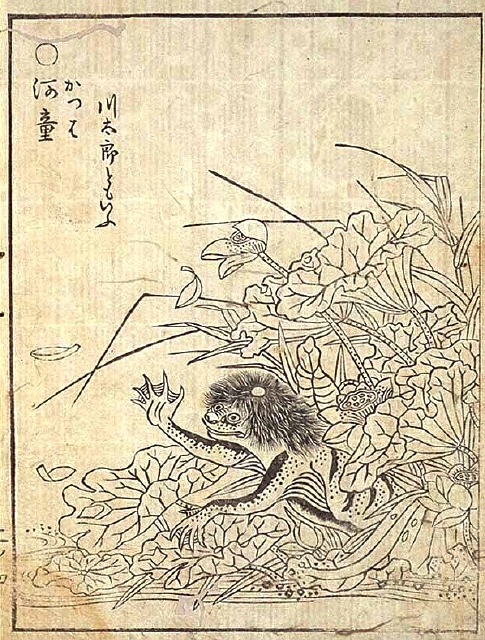
A familiar outline can conceal variety
A small body, a water-filled dish on the head, a fondness for cucumbers and sumo: the National Diet Library’s 1997 exhibition booklet begins with recognizable kappa features. Yet its annotated reading list immediately makes that outline less secure. In discussing regional traditions, it notes identifications with turtles, otters and birds. The figure can be familiar without having one universally accepted body. A drawing that looks definitive may represent only one way of picturing the creature. [1]
The booklet also distinguishes the subjects gathered around this image: folklore, research, painting and fiction. Its annotations are a guide to published accounts, rather than observations of an animal. That distinction makes the variety more interesting. An illustrator and a storyteller need not solve the same problem. One needs an immediately recognizable figure; another can build an encounter around a voice, an action or a frightening presence. Familiar features help stories travel, but they cannot replace the details of an individual account. [1]
A prefecture contains more than one vocabulary
A 2016 paper in the Miyazaki Prefectural Museum’s research bulletin brings the regional scale into focus. It records Sekoppo around Kitagawa in northern Nobeoka, Hyossunbo and Hyōsunbo in central areas including Takanabe and Tsuno, and Garappa or Gawaro around Miyakonojo in the west. Even within one prefecture, the word kappa can sit above a much more detailed vocabulary. Retaining those names preserves something that a nationwide creature list would flatten. [2]
The paper also mentions sea-dwelling kappa stories in Hyūga and a mountain-to-river being in the Shiromi district of Saito. These examples complicate the simple picture of a creature permanently stationed in a freshwater pool. The researcher organizes accounts by narrative subjects, including encounters, gratitude, harmful acts and customs. Our reading is that place and action belong beside appearance: where the being moves and what happens between it and people can distinguish traditions as clearly as a shell or a pointed mouth. [2]
A local character can have responsibilities
Munakata City’s cultural-history account introduces Chōtarō as a leader among local kappa. In the story, the religious official Ujikuni rebukes him because kappa at Eguchi and Tebika have been causing trouble. Chōtarō then uses clever tactics to punish the offenders. The significant detail is a relationship of authority: this particular kappa is expected to answer for others. He has a social position within the tale, beyond membership in a supernatural category. [3]
The same municipal account describes a wider range of kappa behavior, from threatening people and horses to helping with agricultural work. Those acts do not resolve into a single temperament. They offer different ways to imagine dealings across the water’s edge. In Chōtarō’s case, the encounter resembles a demand for responsible leadership. Reading it as a local narrative keeps its named characters and obligations visible. Calling every kappa merely mischievous would lose the particular problem that this story asks its leader to solve. [3]
Water gives the image a changing setting
Nagano Prefectural Museum of History framed its 2018 kappa exhibition around changing relationships with water. Its introduction describes watersides as places of production and prayer, where a necessary resource could also bring disaster. It presents kappa as figures moving between human and watery worlds, sometimes associated with good fortune and sometimes with fear. This is the museum’s interpretive framework for an exhibition, not a single origin account that every regional tradition must follow. [4]
The selected materials ranged from an Edo-period Yoshitoshi print of Shirafuji Genta to a 1937 kappa work by Ogawa Usen. Their presence in one exhibition puts different moments of representation into conversation without making their images interchangeable. The useful question becomes what each setting asks the creature to express. A recognizable kappa can carry changing concerns because it already belongs at a boundary people continually negotiate. Local names, narrative roles and historical images are therefore part of its identity, rather than distractions from a supposedly correct design. [4]
Official sources
Sources were checked on 2026-10-15. These features interpret Japanese folklore and performance from institutional research. Fictional events and attributed beliefs are distinguished from historical evidence. One image (Toriyama Sekien's kappa) is reproduced from Wikimedia Commons in the public domain and credited with the image.
- 第82回常設展示 河童物語 — National Diet Library. Checked 2026-10-15.
- 県内の河童伝承について, 宮崎県総合博物館研究紀要36 (2016) — Miyazaki Prefectural Museum, via J-STAGE. Checked 2026-10-15.
- 026 河童を探せ! — Munakata City, Umi no Michi Munakata-kan. Checked 2026-10-15.
- 君は河童を見たか!−水辺の出会い− — Nagano Prefectural Museum of History. Checked 2026-10-15.