GIZUMO JAPANESE OCCULT · FOLKLORE & PERFORMANCE
Ushi-oni: Between Story and Procession
A frightening name connects regional encounters, a fisherman’s comic reversal, and the communal craft of Uwajima’s festival processions.
Existing subject: Yōkai · Narrative: folklore · Spoilers: plot-spoilers
Content note: Brief descriptions of frightening encounters; discussion of religious processions.
Regional Japanese folklore, especially Shimane; the distinct festival culture of Uwajima and southern Ehime.
A name that needs a location
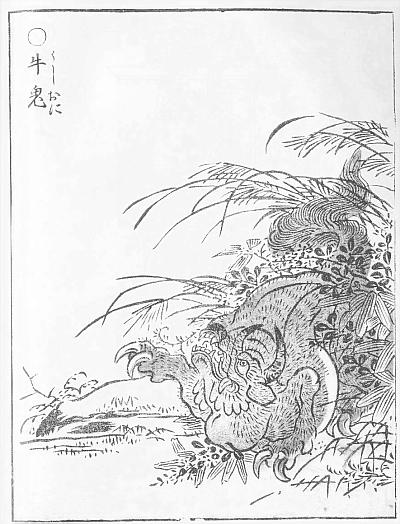
Ushi-oni becomes more interesting when its name stops functioning like a species label. A recorded encounter in Shimane and a procession in southern Ehime can share that name without describing the same body or social role. Reading them together reveals several ways communities made an uncanny presence recognizable: through a neighbour’s explanation, a memorable story, or an object carried through familiar streets. The surviving records invite comparison, but they do not establish that any supernatural encounter occurred. [UO1] [UO2]
Recognizing the unexplained
Nichibun’s folklore database summarizes an account attributed to Wada Uko’s Issetsu machimachi in which prolonged rain and damp weather accompany an encounter near a bridge. White, shining things flutter around a traveller and cling to him as he crosses. People at a nearby house identify what happened as an encounter with ushi-oni. The account does not supply the elaborate anatomy a modern creature guide might lead readers to expect. [UO1]
One possible reading places the emphasis on interpretation itself. The traveller brings an unsettling experience; local knowledge gives it a name. A bridge, weather, movement, and a conversation do the narrative work that a detailed monster portrait would do elsewhere. Uncertainty is part of the record’s texture. [UO1]
A fisherman changes the balance
A different Shimane account, published in 1933 and indexed by Nichibun, gives an elderly fisherman unexpected control. He catches an approaching ushi-oni and brings it ashore. When a spectator strikes it with an oar, it proves to be an old camellia root. The summary also records a belief that camellias could transform, connecting the reversal to local understandings of plants. [UO3]
Here, the revealing object does not simply cancel the uncanny. Within the story’s framework, an ordinary root and a transforming presence can belong to the same explanation. The fisherman’s confidence also changes the emotional register: the terrifying name supports a tale of practical nerve and public inspection. [UO3]
The procession has its own history
Uwajima City describes its festival ushi-oni as an attendant that precedes the portable shrine. Its bamboo framework, cloth or palm covering, long neck, and paper head require collective manufacture and carrying. Calling this object merely an attacking monster would erase its ceremonial job. Its fierce appearance belongs within an organized procession. [UO2]
The city’s account identifies a 1784 document as the earliest known record of this festival form and treats its precise beginnings as uncertain. That distinction matters: evidence for a procession and legends about an ancient creature answer different historical questions. The festival figure deserves a history of its own. [UO2]
An everyday emblem
Uwajima introduced ushi-oni licence plates for small motorbikes in 2012 and announced an expansion in 2020. This modest administrative record adds another setting for the name: ordinary civic life. Ushi-oni can carry local identity as well as fear, humour, or ceremonial responsibility. Its cultural richness lies in those different uses, rather than in one definitive inventory of powers. [UO4]
Sources and original texts
Original cultural readings of folklore, fiction and artistic representations. Interpretations are distinguished from source descriptions. Access to a collection record does not grant permission to reproduce its images or text. No supernatural event is verified.
- 牛鬼 | ウシオニ, record 3140004 — International Research Center for Japanese Studies (Nichibun). Checked 2026-10-15.
- 宇和津彦神社の秋祭り — Uwajima City; article by Ehime Museum curator Takahisa Omoto. Checked 2026-10-15.
- 牛鬼 | ウシオニ, record 0640485 — International Research Center for Japanese Studies (Nichibun). Checked 2026-10-15.
- 牛鬼ナンバープレートの拡充等について — Uwajima City. Checked 2026-10-15.
Original English cultural analysis. Institutional source descriptions are paraphrased, and interpretive conclusions are identified as readings. No source prose is reproduced. One image (Toriyama Sekien's ushi-oni) is reproduced from Wikimedia Commons in the public domain and credited with the image.