GIZUMO JAPANESE OCCULT · FOLKLORE & PERFORMANCE
Kurozuka: The Room a Guest Must Not Open
The noh play also called Adachigahara makes hospitality, repetitive work, and a forbidden room carry its terror.
Existing subject: Yōkai · Narrative: folklore · Spoilers: plot-spoilers
Content note: Discovery of human remains, implied cannibalism, pursuit, and the depiction of a woman as an oni.
Kurozuka/Adachigahara in Japanese noh, with a brief distinction from the later kabuki dance; no claim that its creature existed.
Hospitality under a condition
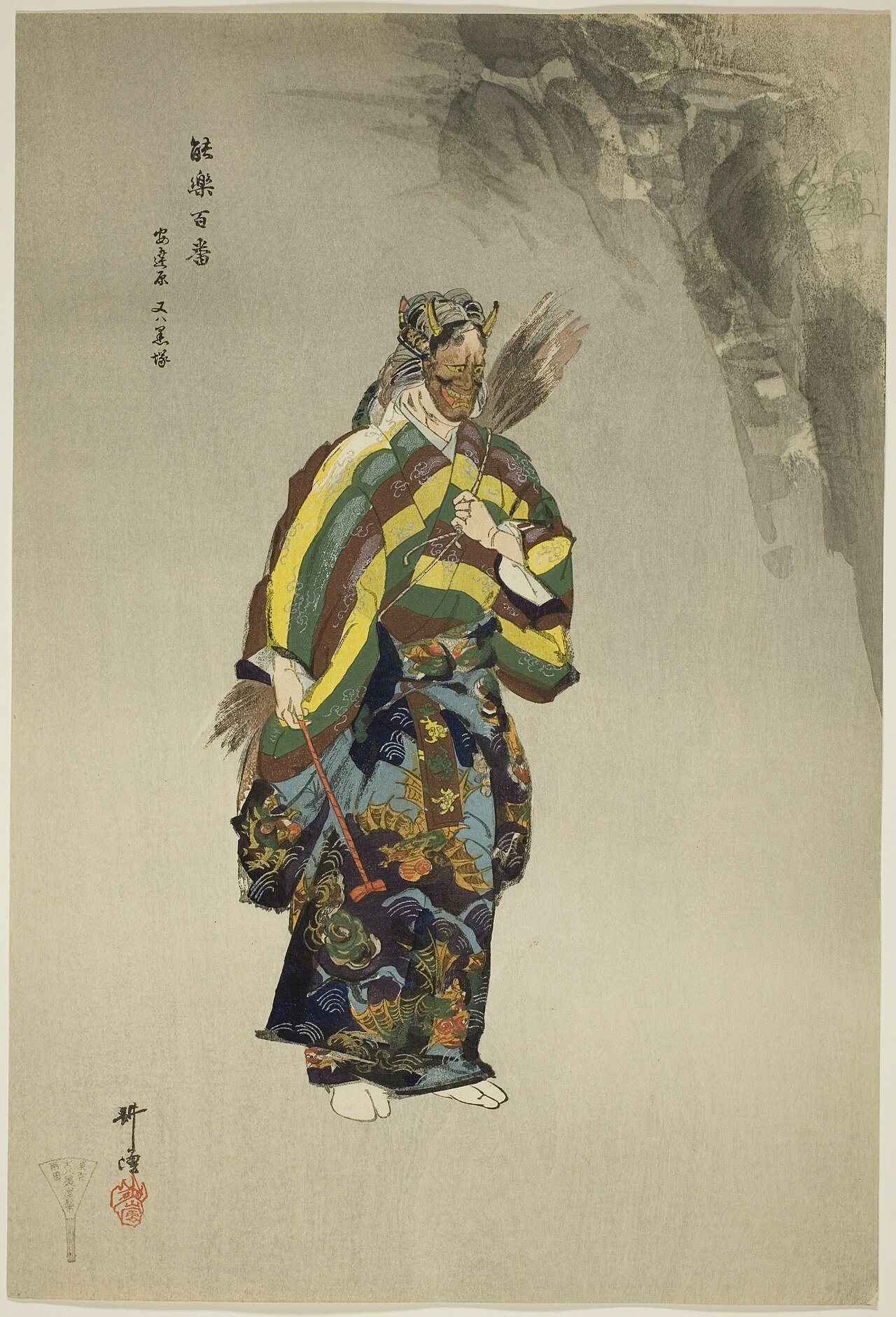
A house offers shelter, then becomes a place from which its guests must flee. In Kurozuka, the travelling priest Yūkei and his companions stay with a woman at Adachigahara. She winds thread and speaks about worldly impermanence; a servant discovers bodies in her room, exposing the household as an oni's dwelling. The encounter ends with the priest subduing her through prayer. The Nohgaku Performers' Association also records the Kanze school's title, Adachigahara, for this drama. [KZ1]
My reading begins with the difficulty of receiving hospitality from someone unknown. The visitors need an interior, yet entering it does not make them its owners. A host's private space remains private even when guests rely on her kindness. The plot's terrible discovery makes the boundary urgent, but it does not make the initial relationship simple. Viewers can feel both the guests' need for safety and the instability of an arrangement in which refuge depends on incomplete knowledge. [KZ1]
A working body before a monstrous one
Fukuoka City Museum's discussion places the play in the Adachigahara landscape of present-day Fukushima and emphasizes the woman's solitary life. Her thread-winding tool, the wakukasewa, belongs to a scene of work and lament. Before collecting firewood for her guests, she forbids them to inspect her sleeping chamber. The museum also cautions that a direct origin in the familiar cannibal-ogress folktale is not established; poetry belongs to the drama's background as well. [KZ2]
It is worth resisting the temptation to make every movement of work a coded warning. As an interpretation, I would let the thread remain thread for a while: something handled, gathered, and worked through. Repetition gives the woman's presence duration before disclosure gives it a frightening explanation. Recognizing that duration does not excuse the violence suggested by the hidden bodies. It does, however, prevent the later revelation from cancelling every impression the earlier performance has made. [KZ2]
Which Kurozuka are we watching?
The title also belongs to a kabuki dance first performed in 1939. Japan Arts Council explains that this later work draws on the noh and includes a moonlit passage in which the woman dances with her shadow. Crucially, its guide says that passage is absent from the noh. A memorable scene from one version should therefore not be imported into another merely because the names and central figures match. [KZ3]
That distinction offers a practical approach to traditional horror: ask what this performance actually gives its character. Does it offer an extended dance, an activity, a speech, or an interval of waiting? Different answers distribute sympathy differently. My reading of the noh rests on the contrast between receiving a stranger's labour and discovering her concealed violence. The forbidden room is horrifying, but the drama also leaves a quieter discomfort: how quickly recognition can turn into a belief that one has understood another being completely. [KZ3]
Sources and original texts
Original cultural readings of folklore, fiction and artistic representations. Interpretations are distinguished from source descriptions. Access to a collection record does not grant permission to reproduce its images or text. No supernatural event is verified.
- Kurozuka — The Nohgaku Performers’ Association. Checked 2026-10-15.
- The World of Noh Masks 6: Distant Provinces in Noh — Fukuoka City Museum. Checked 2026-10-15.
- Kabuki Dance: Kurozuka — Japan Arts Council. Checked 2026-10-15.
Original English cultural analysis. Institutional source descriptions are paraphrased, and interpretive conclusions are identified as readings. No source prose is reproduced. One image (Tsukioka Kōgyo's Noh illustration of Adachigahara (Kurozuka)) is reproduced from Wikimedia Commons in the public domain and credited with the image.