GIZUMO JAPANESE OCCULT · FOLKLORE & PERFORMANCE
Sesshōseki: When the Killing Stone Begins to Speak
Tamamo-no-Mae’s story becomes a drama of warning, disclosure, and a promise to stop causing harm in the noh Sesshōseki.
Existing subject: Yōkai · Narrative: folklore · Spoilers: plot-spoilers
Content note: Legendary illness, the killing of a fox spirit, and harm to living creatures; supernatural events are discussed as drama.
The specific Japanese noh Sesshōseki, set at Nasu, rather than a combined biography drawn from every Tamamo-no-Mae tradition.
A warning from the danger itself
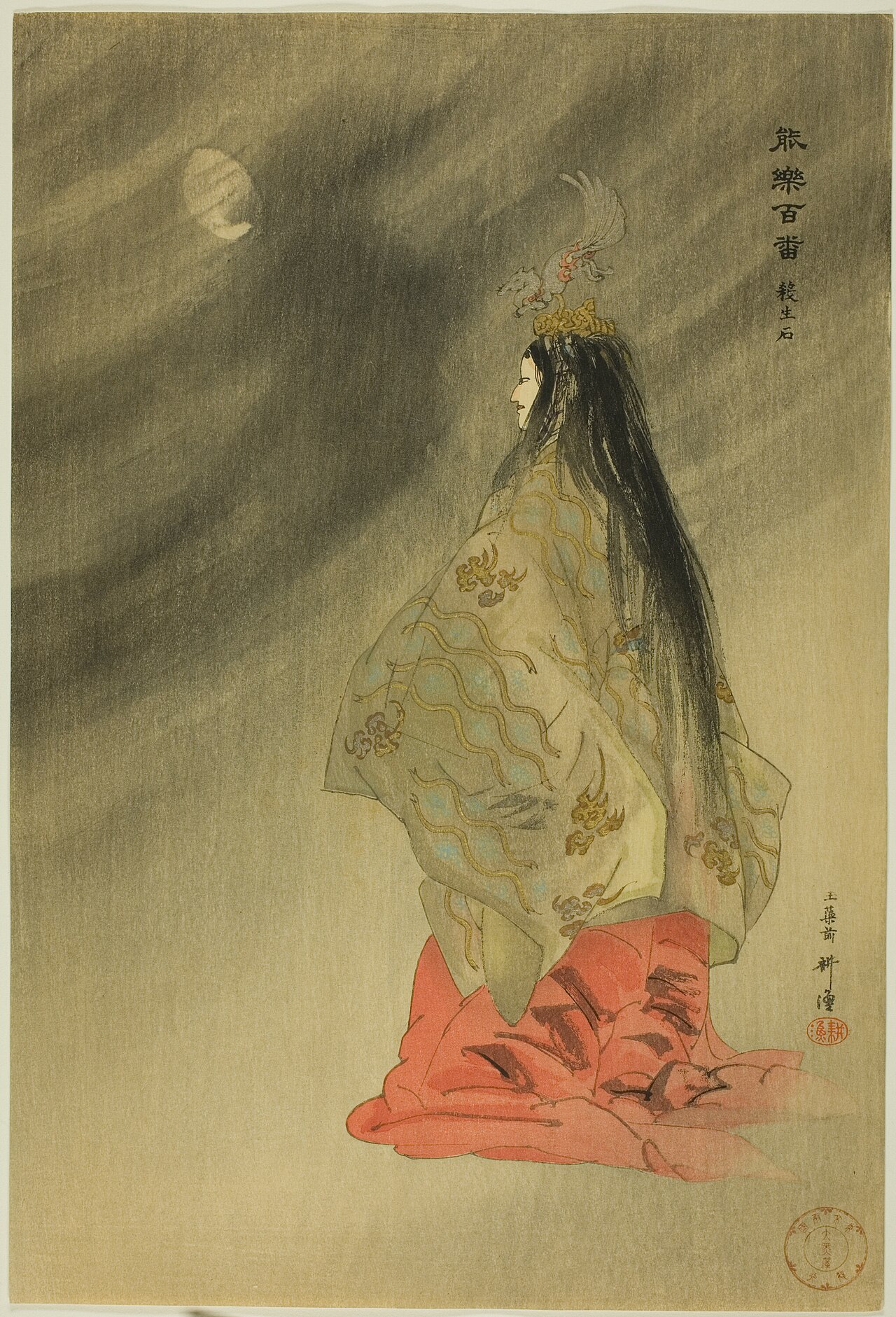
In the noh Sesshōseki, the monk Gennō encounters a woman near a dangerous stone at Nasu. She explains its connection to Tamamo-no-Mae, the fox spirit who appeared at the court of the retired emperor Toba, and then reveals that she is the stone's spirit. Japan Arts Council's synopsis makes her initial action especially striking: she prevents the monk from approaching the hazard. The threatening presence introduces itself through a warning. [SS1]
That detail invites an interpretation different from a simple encounter between an unsuspecting traveller and a hidden predator. The spirit participates in making its own danger intelligible. It gives the visitor a reason to stop, then supplies a history for what he sees. In my reading, this creates a small opening between what a being has done and what it may yet say. Speech becomes an event with consequences, even before the drama offers any resolution to the harm. [SS1]
The face beyond a familiar fox
A museum object complicates the expectation that the revealed creature must resemble an ordinary fox. Cultural Heritage Online records an eighteenth-century painted wooden yakan mask held by Tokyo National Museum. Its description identifies short horns, a projecting mouth, and fangs, and connects the mask with the spirit in Sesshōseki. The catalogue notes that yakan has long served as another name for a fox in Japan, while also having a different imaginative background in China. [SS2]
The useful distinction is between naming an animal and constructing a theatrical presence. My interpretation is that the mask does not ask an audience to mistake a performer for wildlife. Its forceful features make a particular kind of encounter readable. Looking at such an object as a performance tool also changes the question we ask: not whether the face is a correct zoological likeness, but what expressive possibilities it gives a human body carrying a role. [SS2]
An ending addressed to the future
The Nohgaku Performers' Association summarizes the conclusion as a response to the monk's rites: the fox spirit promises to commit no further wrongdoing and disappears. This wording matters. It directs attention toward future conduct, rather than merely counting the defeats suffered by a dangerous being. It is also a reason to keep this particular drama distinct from other stories, images, or modern adaptations bearing Tamamo-no-Mae's name. [SS3]
I read that promise as the play's most consequential transformation. A stone seems incapable of negotiation; a speaker can undertake to change. The drama moves between those possibilities without requiring today's audience to accept the existence of a killing stone or a fox spirit. Its cultural interest lies partly in imagining how an enduring threat might acquire an ending. The closing pledge does not make earlier suffering disappear. It asks whether the continuation of harm can be interrupted, and gives that possibility the vulnerable form of a spoken commitment. [SS3]
Sources and original texts
Original cultural readings of folklore, fiction and artistic representations. Interpretations are distinguished from source descriptions. Access to a collection record does not grant permission to reproduce its images or text. No supernatural event is verified.
- Sesshōseki — Noh and Zeami — Japan Arts Council. Checked 2026-10-15.
- Noh Mask: Yakan — Agency for Cultural Affairs / Tokyo National Museum. Checked 2026-10-15.
- Sesshōseki — The Nohgaku Performers’ Association. Checked 2026-10-15.
Original English cultural analysis. Institutional source descriptions are paraphrased, and interpretive conclusions are identified as readings. No source prose is reproduced. One image (Tsukioka Kōgyo's Noh illustration of Sesshōseki) is reproduced from Wikimedia Commons in the public domain and credited with the image.