GIZUMO JAPANESE OCCULT · FOLKLORE & PERFORMANCE
Ubume: Maternal Presence and the Work of Remembering
A maternal ghost, a quiet roadside encounter, and a living devotional tradition reveal different ways of imagining birth, loss, and continuing care.
Existing subject: Yōkai · Narrative: folklore · Spoilers: premise-only
Content note: Death during pregnancy or childbirth, bereavement, and historical religious representations of suffering.
Japanese ubume traditions, with medieval and early modern literary history, a Yonezawa account, and distinct devotional practice at Daigyōji in Kamakura.
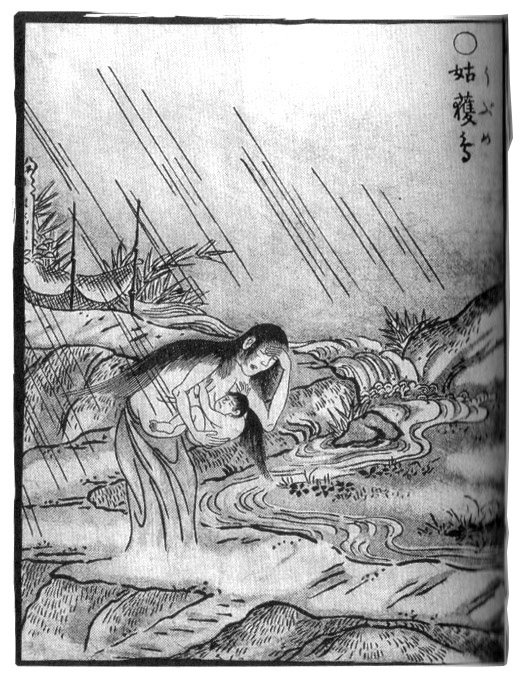
The person within the apparition
Ubume brings pregnancy and childbirth into the ghost story. Literary scholar Satoko Shimazaki describes a figure capable of evoking both a woman’s suffering and her continuing concern for a child. That combination makes the apparition emotionally difficult: an audience can fear her return while recognizing a relationship interrupted by death. The ghost is a cultural representation, not a judgement on women who have experienced pregnancy loss or died in childbirth. [UB1]
Shimazaki also shows why this image should not be projected unchanged into every period. The early twelfth-century Konjaku monogatarishū leaves competing explanations for one encounter, including a fox’s trick and a woman’s spirit. A later rewriting removes that uncertainty and gives the figure a more definite visual form. What appears to be a timeless character has been shaped by editing, illustration, and expectations about what readers already know. [UB1]
An encounter almost without a plot
A Yonezawa account makes the familiar gesture of holding a child unsettling without describing an attack. Nichibun’s database summarizes a recollection published by Tadashi Takeda in 1979: while fetching mulberry leaves for silkworms, a young man sees a woman seated on stacked wood beside a river, holding a child. She waves and greets him. When she is still there on his return, he becomes frightened and runs home. [UB2]
The everyday details matter. Work, kinship, a striped kimono, and a greeting place the encounter inside ordinary life. Reading the summary closely, we cannot supply the woman with an unrecorded death, motive, or threatening speech. The fear belongs to the witness’s response. This version allows an apparently ordinary maternal presence to remain unresolved rather than turning it into a complete biography of a monster. [UB2]
A different relationship at Daigyōji
Kamakura’s official tourism association describes Daigyōji as enshrining the ubume reijin called Onme-sama, revered by people praying for safe childbirth. The association identifies both the honoured presence and the purpose of devotion, giving readers a concrete contemporary setting for a name often encountered in collections of supernatural tales. This living devotional context requires its own vocabulary. The enshrined presence should not be flattened into the hostile creature of a supernatural bestiary, and the existence of worship should not be presented as proof that prayer determines a medical outcome. [UB3]
Placed beside the Yonezawa account, the temple offers a different relationship to a maternal presence. A frightened passerby withdraws; worshippers approach with hopes for childbirth. The contrast suggests a useful cultural question: what forms of attention does a community give to vulnerability? A story and a place of worship can make room for different answers without sharing a single origin or meaning. [UB2] [UB3]
Keeping the differences audible
Ubume therefore rewards attention to who is speaking, and in what setting. A rewritten tale can make an apparition more definite, while a remembered encounter preserves uncertainty. Neither needs to erase the maternal suffering that later readers may hear in the name. [UB1]
Sources and original texts
Original cultural readings of folklore, fiction and artistic representations. Interpretations are distinguished from source descriptions. Access to a collection record does not grant permission to reproduce its images or text. No supernatural event is verified.
- The End of the “World”: Tsuruya Nanboku IV’s Female Ghosts and Late-Tokugawa Kabuki — Satoko Shimazaki; Monumenta Nipponica 66/2, Sophia University; copy hosted by University of Chicago. Checked 2026-10-15.
- 産女 | ウブメ, record 0330008 — International Research Center for Japanese Studies (Nichibun). Checked 2026-10-15.
- 大巧寺 — Kamakura City Tourist Association. Checked 2026-10-15.
Original English cultural analysis. Institutional source descriptions are paraphrased, and interpretive conclusions are identified as readings. No source prose is reproduced. One image (Toriyama Sekien's ubume) is reproduced from Wikimedia Commons in the public domain and credited with the image.