GIZUMO JAPANESE OCCULT · FOLKLORE & PERFORMANCE
Ubazakura: A Tree That Remembers Care
Hearn’s milk-nurse legend makes a flowering tree remember a woman’s caregiving, while leaving the cost of her sacrifice open to scrutiny.
Existing subject: Ghost stories · Narrative: folklore · Spoilers: plot-spoilers
Content note: Severe illness of a teenager, death, bereavement, and a caregiver’s wish to die in another person’s place. The story presents a supernatural sacrificial exchange, not a described act of suicide.
Close reading of Hearn’s 1904 rendition set at Saihōji in the former province of Iyō. The essay discusses the story’s tree and dates as narrative claims, without asserting a verified miracle, botanical record, or general Japanese memorial custom.
Whose story survives?
“Ubazakura” begins with a wealthy village headman who wants a child, but it ends by naming a tree after the woman hired to nurse his daughter. That movement changes the story’s center of gravity. The father’s status supplies the opening circumstances; O-Sodé’s care supplies the enduring memory. In Hearn’s brief account, the nurse is neither a passing servant nor a substitute who disappears once childhood ends. Her attachment remains decisive when the girl, O-Tsuyu, becomes dangerously ill at fifteen. [UBAZAKURA]
Hearn describes O-Sodé’s affection in maternal terms, although she is not O-Tsuyu’s mother. The distinction matters because the story places a relationship made through care alongside biological parenthood. She has fed the child and later prays for her recovery. Read through this emphasis, the tale asks what a family owes someone whose work has helped sustain its life. The answer eventually takes a public, lasting form, but it begins in intimate dependence: a baby requires nourishment that another woman provides. [UBAZAKURA]
Gratitude and an uncomfortable exchange
The recovery and the nurse’s death are linked through her final disclosure. She says that she asked Fudō to let her die in the girl’s place, and understands her approaching death as the answer. This is O-Sodé’s explanation within Hearn’s supernatural narrative, not evidence that illness can be transferred by prayer. Her gratitude is also difficult for a modern reader: the story honors her affection through a sacrifice that removes her from the life she has protected. That tension deserves attention rather than an automatic celebration. [UBAZAKURA]
O-Sodé leaves the family a specific obligation. She has promised a cherry tree at Saihōji as both thanksgiving and commemoration, and asks them to fulfill the promise she cannot complete. The parents do so after her funeral. On this reading, remembrance is not merely an emotion the survivors happen to feel. It is work transferred to them by the dying woman, with a location and a material form. Her last request gives her some authorship over how the household will remember her. [UBAZAKURA]
A body remembered through blossoms
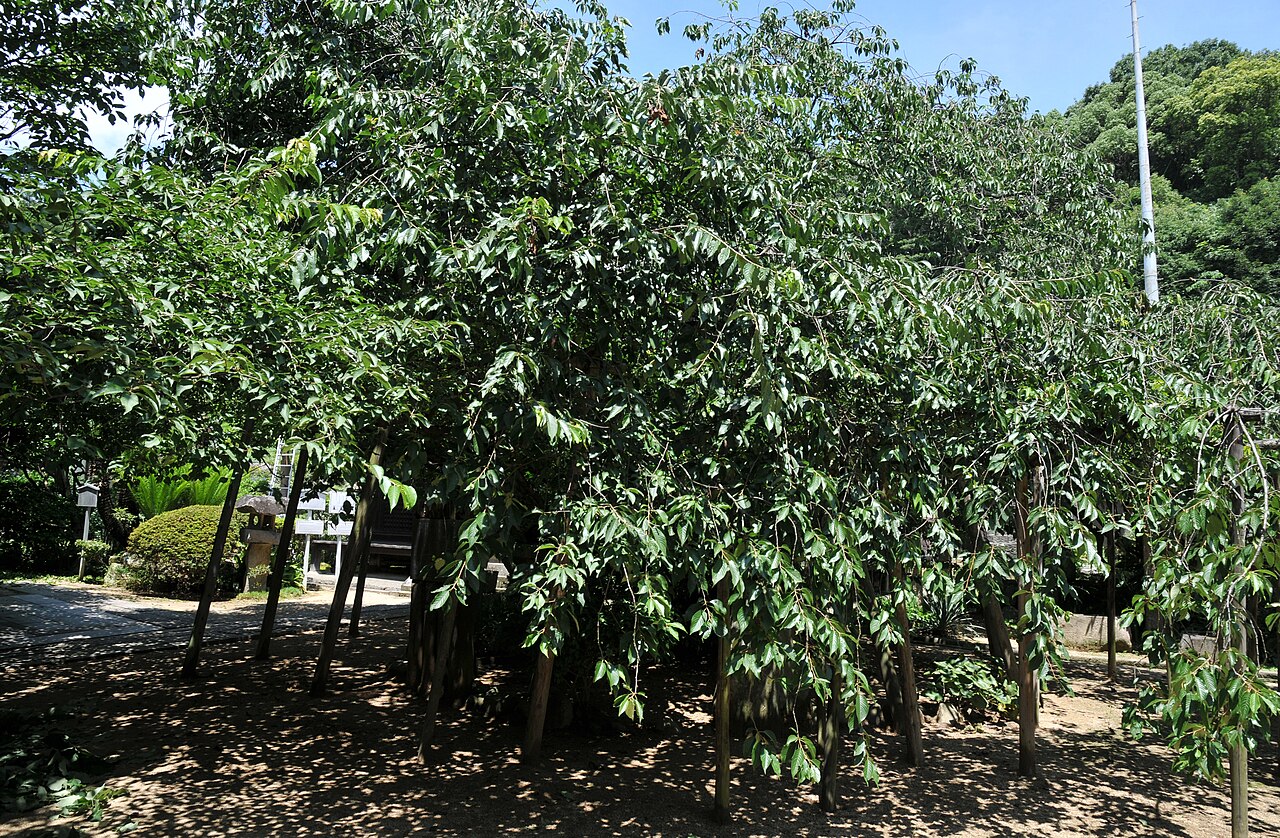
The blossoms make that memory unusually bodily. Hearn describes their pink and white forms through the imagery of nursing breasts and milk. The comparison connects the tree to O-Sodé’s life-giving labor rather than simply to beauty. Nothing in the text requires us to call the tree her reincarnation or to claim that her ghost inhabits it. Its stated function is commemorative. The resemblance allows the care she once provided to remain visible in a form that other people can recognize and name. [UBAZAKURA]
The tree flowers on the anniversary of her death, and Hearn’s account says this continues for 254 years. Those precise claims belong to the legend; they are not a flowering schedule for present-day visitors. Their literary effect is to make remembrance recurrent. The family’s loss becomes a date that returns, while the nurse’s name survives through the tree’s identity. What begins as a household’s good fortune ends as a question about historical attention: whose care receives a lasting place in the landscape? [UBAZAKURA]
Sources and original texts
Original cultural readings of folklore, fiction and artistic representations. Interpretations are distinguished from source descriptions. Access to a collection record does not grant permission to reproduce its images or text. No supernatural event is verified.
- Lafcadio Hearn, “Ubazakura,” in Kwaidan (1904) — Project Gutenberg; original author Lafcadio Hearn. Checked 2026-10-15.
- Kwaidan: Stories and Studies of Strange Things — bibliographic and rights record — Project Gutenberg. Checked 2026-10-15.
Original critical essay based on Lafcadio Hearn’s 1904 English text, as transcribed in Project Gutenberg eBook 1210. Project Gutenberg lists the work as public domain in the USA. No modern translation or digitizer commentary is reproduced. [PG1210]