GIZUMO JAPANESE OCCULT · FOLKLORE & PERFORMANCE
Why Some Noh Ghosts Return Twice
Dream noh can make recollection into dramatic action. The returning figure asks the audience to experience a life, rather than simply learn about it.
An introduction to two-part mugen noh, not every noh play.
Content note: Explains recurring dramatic structures involving death and remembrance; no full play ending is retold.
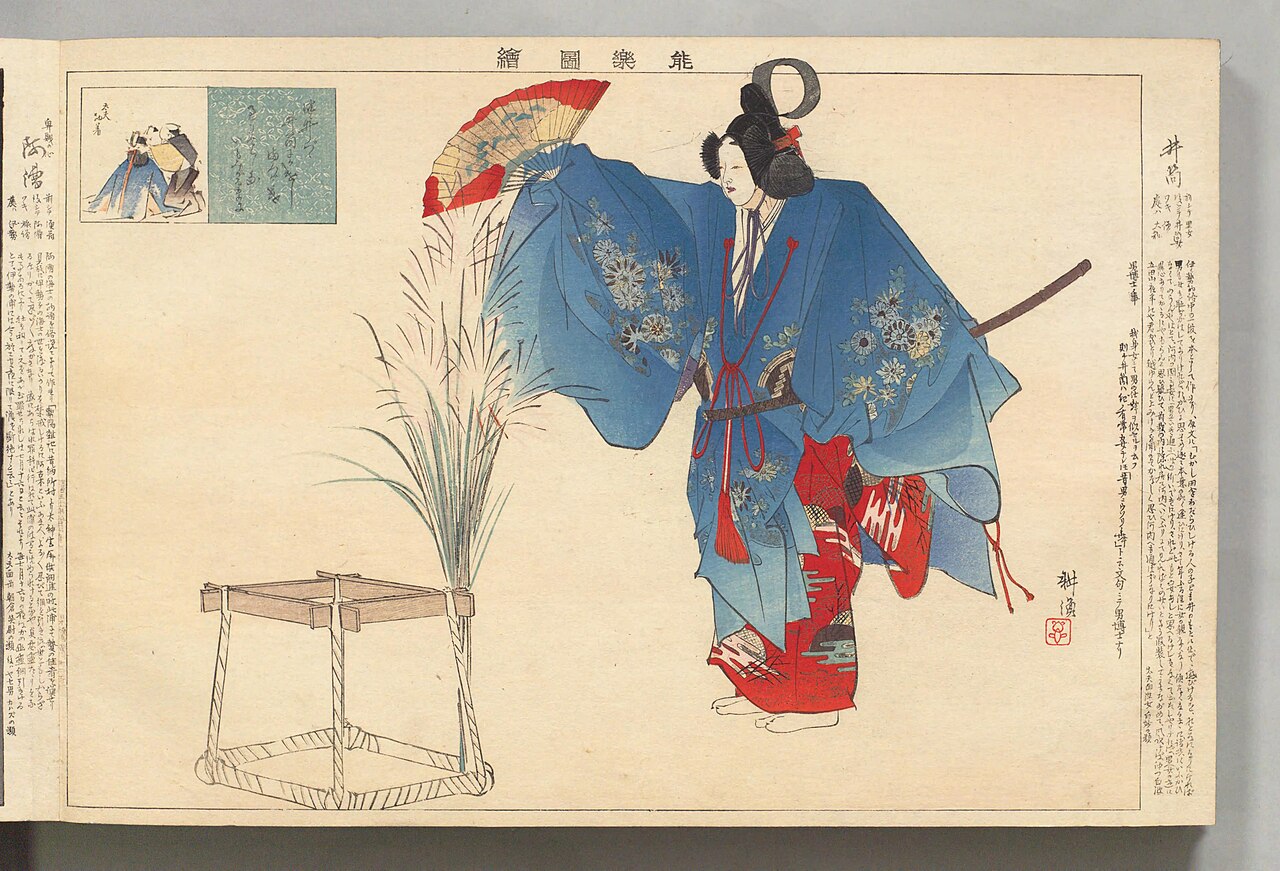
The first encounter leaves something unfinished
In the Japan Arts Council’s guide to a representative two-part dream noh, a traveler reaches a place and encounters a figure who initially appears human. Their conversation connects the location with an earlier story. Before leaving, the figure hints at a different identity. A kyogen actor then supplies local narrative within the noh performance. This intervening role should not be confused with a separate comic play inserted simply to dispel the mood. The encounter prepares another kind of return. [1]
The principal performer reappears in the character’s true form, recalling the past through song and dance before the dream ends at dawn. The council illustrates the sequence with Izutsu. Its account gives a useful map of a particular dramatic pattern, not a rule for every noh performance. Recognizing that pattern changes the question from who this visitor really is to why the visitor must return, and what remained unsaid in the first encounter. [1]
Remembering has its own dramatic time
Ohtsuki Noh Theatre distinguishes mugen noh, organized around the principal character’s recollections, from genzai noh, in which events generally proceed chronologically. This distinction helps explain why the second appearance is not merely another surprise. A remembered event can become the dramatic present. The character returns to something that has already happened, while the spectator experiences its unfolding now. The form makes room for repetition because repeating the past can be the very action that matters. [2]
The theatre’s introduction also describes spirits returning with unresolved attachments and seeking religious release. Those ideas belong to the plays’ imaginative and religious framework; the theatre is explaining drama, not documenting an encounter with a spirit. Our reading therefore treats the return as a change in access. The earlier conversation offers an account of a life. The later appearance allows its emotional burden to occupy the stage, rather than remaining a piece of information delivered to the traveler. [2]
A change of clothing can carry a revelation
The Metropolitan Museum of Art’s essay on noh costume describes how clothing can signal a character’s identity and change as that identity is disclosed. It also emphasizes the visual weight of layered textiles on a comparatively spare stage. Costume is doing work that a crowded realistic set might otherwise perform. A returning figure can be understood through the arrangement and presence of the garments, not only through an explanation spoken aloud. The revelation has a material shape. [3]
The museum cautions against imagining this as unrestricted personal styling. Garment combinations and ways of wearing them are codified for roles, while choices of color and pattern leave room for a performer’s judgment. For a reader encountering a costume photograph, that distinction is productive: a striking robe is both an object and part of a theatrical language. Its meaning depends on the role and its place in the performance, rather than on decorative richness alone. [3]
The face moves without changing its carving
The Nohgaku Performers’ Association explains that slight changes in a mask’s angle can produce impressions of brightness or sadness. Carving and painting establish surfaces that respond to movement and light. A photograph preserves one angle; a performance gives the face time. The association also notes that masks generally identify types of characters rather than unique individuals. Ko-omote, for example, may represent a young woman but can also serve female deities or spirits. [4]
This makes a mask an invitation to read the performance, rather than a complete identification label. Its shape alone does not explain a character’s whole history. Our reading of the ghost’s return rests on that distinction between an object and its enactment. Movement can make a familiar face newly expressive without replacing the carving. The returning character becomes present through a performer’s sustained choices, and an apparently fixed surface acquires a changing emotional life while the audience watches. [4]
Official sources
Sources were checked on 2026-10-15. These features interpret Japanese folklore and performance from institutional research. Fictional events and attributed beliefs are distinguished from historical evidence. One image (Tsukioka Kōgyo's Noh illustration of Izutsu) is reproduced from Wikimedia Commons in the public domain and credited with the image.
- 能の進行: 舞台の流れ — Japan Arts Council. Checked 2026-10-15.
- Noh Plays — Ohtsuki Noh Theatre. Checked 2026-10-15.
- Nō Costume — The Metropolitan Museum of Art. Checked 2026-10-15.
- Nō masks — The Nohgaku Performers’ Association. Checked 2026-10-15.