GIZUMO JAPANESE OCCULT · FOLKLORE & PERFORMANCE
Atsumori: Remembering an Enemy Without Erasing Him
A close reading of Atsumori’s grass cutter, returning warrior, and former killer, exploring how remembrance changes the relationship between enemies.
Existing subject: Ghost stories · Narrative: fiction · Spoilers: plot-spoilers
Content note: Discussion of a young person’s death in war, remorse, and religious memorial practice.
The Japanese noh play Atsumori and its theatrical treatment of a story associated with The Tale of the Heike.
The witness is implicated
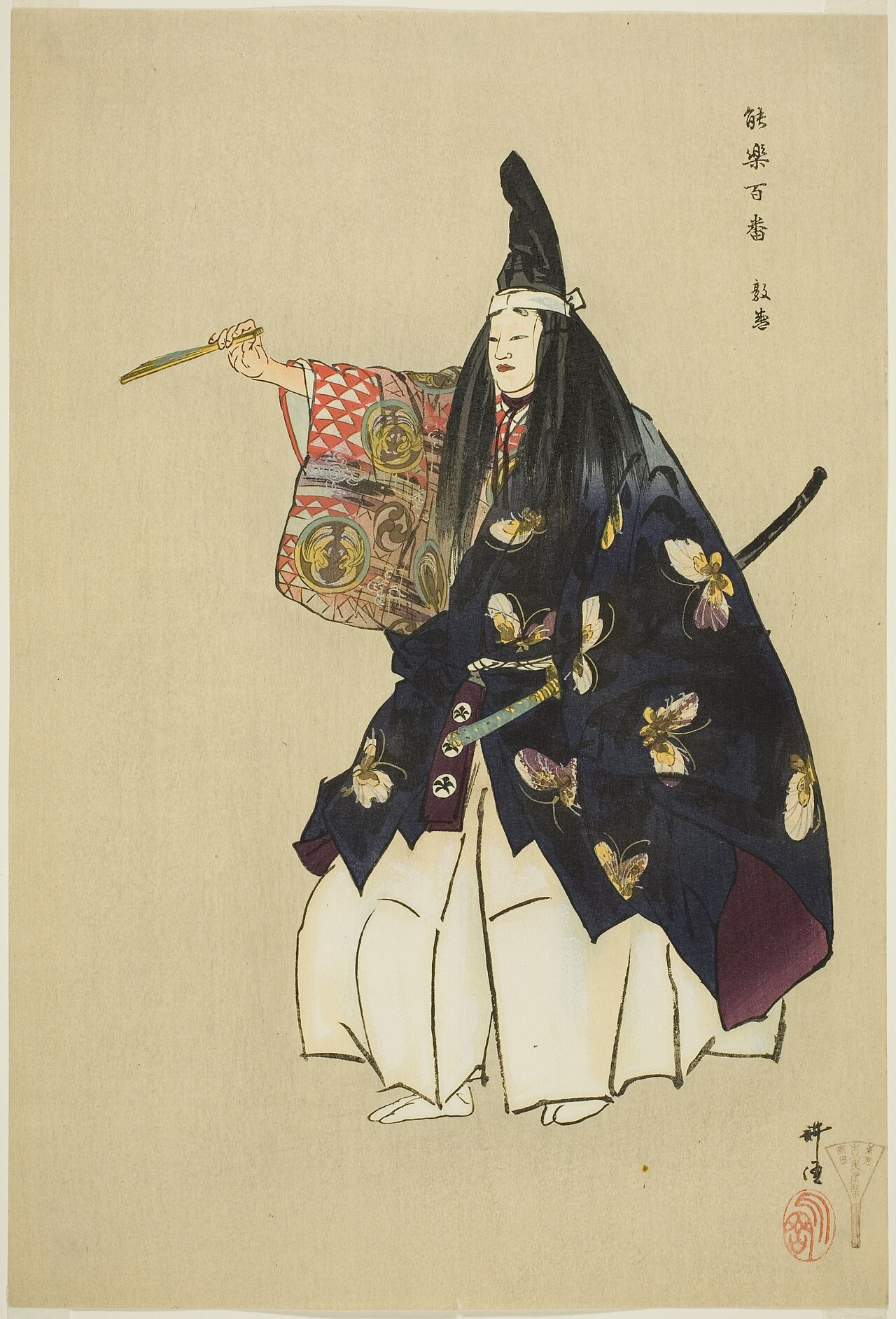
In Atsumori, the person attending to the dead is also responsible for the death. The Nohgaku Performers’ Association introduces Rensei as the former warrior Kumagai Naozane, visiting Suma to pray for the Atsumori he killed. A grass cutter hints at his identity before the armored ghost returns. The association identifies the play as warrior noh and emphasizes the pathos of a fighter who died at sixteen. Its supernatural action belongs to a dramatic account of memory. [AT1]
This arrangement prevents remembrance from being comfortably detached. My reading is that Rensei cannot place violence safely elsewhere, among the deeds of distant rulers or anonymous armies. The person requiring care is someone he harmed. Equally, Atsumori is allowed to appear as more than the occasion for another man’s remorse. The encounter keeps two demands in view: that the survivor acknowledge what he did, and that the dead retain a particular identity beyond that acknowledgement. Listening becomes an ethical action here, because it requires the listener to remain present to a story he cannot innocently observe. [AT1]
Music before military identity
In Columbia University’s recorded introduction, Donald Keene draws attention to the apparently ordinary reaper whose flute marks him as unusual. Keene connects the drama to The Tale of the Heike and distinguishes its opening encounter from the later return in splendid warrior dress. The sequence matters: spectators meet a person through work and music before receiving the full visual declaration of martial identity. [AT3]
The flute can consequently be heard, in this interpretation, as a refusal to let the battlefield monopolize Atsumori’s image. It does not undo the killing or supply a cheerful alternative biography. It introduces another measure of the life being remembered. A useful viewing question is what changes when the same figure becomes recognizably a warrior: does the earlier musical encounter remain audible in the audience’s imagination, or does armor threaten to absorb everything that preceded it? [AT3]
Reconciliation as continuing attention
The National Noh Theatre’s account of a 2025 performance explains that the returning Atsumori reenacts his death, then recognizes his former enemy as a companion in Buddhist practice. Before disappearing, he requests further memorial prayers. That last request is significant. The action moves toward reconciliation, but its closing gesture still asks something of the living. The religious relationship continues beyond the moment of recognition. [AT2]
For a contemporary reader, that ending can resist the idea that reconciliation is a single emotional achievement. This is an interpretive analogy, not a claim that the play expresses a modern therapeutic theory. Rensei’s changed identity cannot reverse the past; what can change is his relation to it. The requested continuation makes care temporal, something sustained rather than merely felt. Atsumori’s return also gives the victim a voice in defining what comes next. The ghost story is thus compelling less for the surprise of an apparition than for its difficult redistribution of attention, obligation, and speech. [AT2]
Sources and original texts
Original cultural readings of folklore, fiction and artistic representations. Interpretations are distinguished from source descriptions. Access to a collection record does not grant permission to reproduce its images or text. No supernatural event is verified.
- Atsumori: repertoire entry — The Nohgaku Performers’ Association. Checked 2026-10-15.
- National Noh Theatre June 2025 performances: Atsumori — Japan Arts Council / National Noh Theatre. Checked 2026-10-15.
- Example of a Noh Play: The Story of Atsumori — Columbia University, Asia for Educators. Checked 2026-10-15.
Original English cultural analysis. Institutional source descriptions are paraphrased, and interpretive conclusions are identified as readings. No source prose is reproduced. One image (Tsukioka Kōgyo's Noh illustration of Atsumori) is reproduced from Wikimedia Commons in the public domain and credited with the image.