GIZUMO JAPANESE OCCULT · FOLKLORE & PERFORMANCE
Funa Benkei: Two Departures, One Unquiet Sea
How an actor’s two roles, a boatman’s labor, and a change of weapons turn Funa Benkei into a study of separation and unfinished war.
Existing subject: Ghost stories · Narrative: fiction · Spoilers: plot-spoilers
Content note: Discussion of warfare, bereavement, and threatened drowning in a traditional play.
Close reading of the Japanese noh play Funa Benkei, rather than a historical account or a claim about real apparitions.
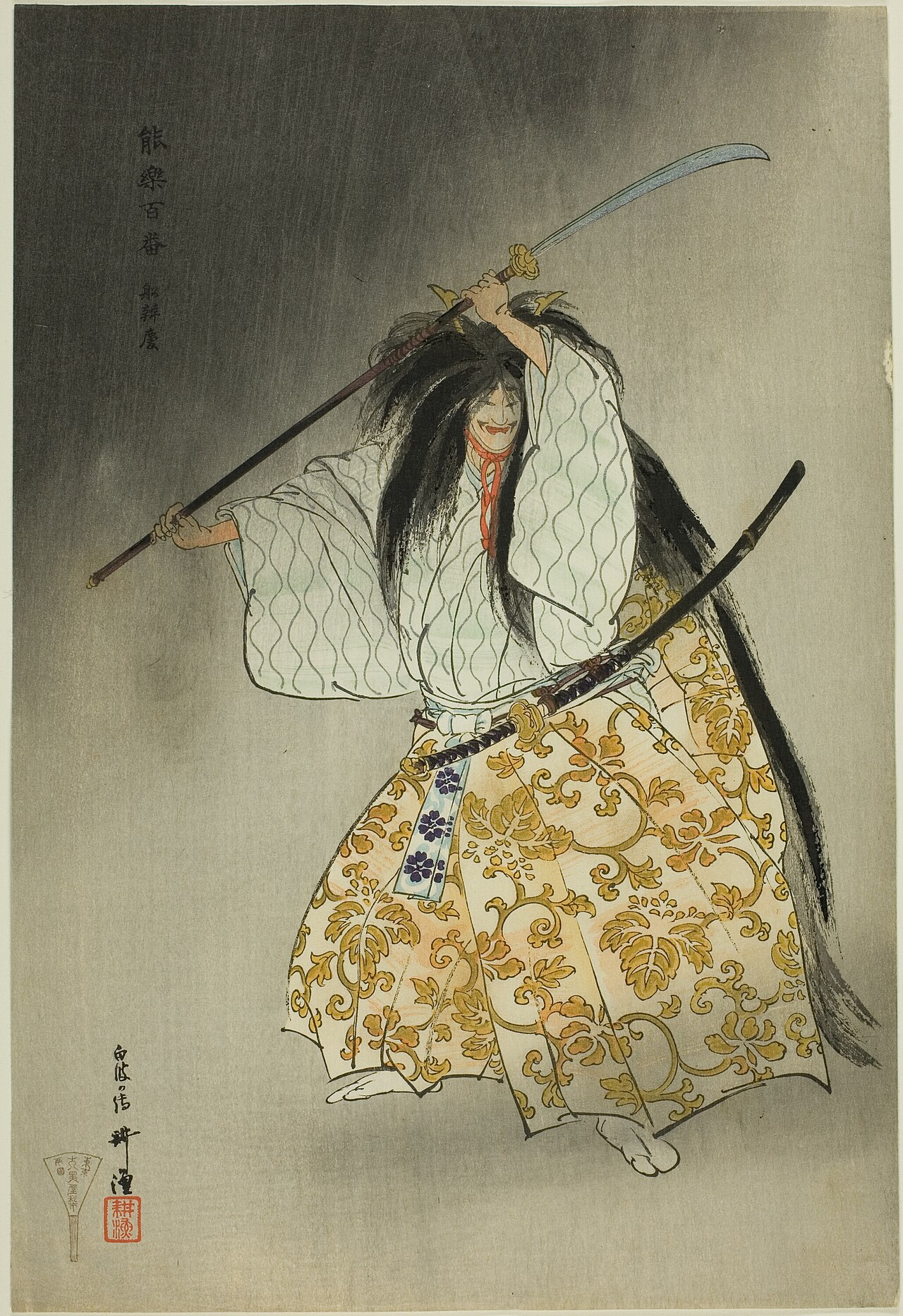
The departure before the haunting
Funa Benkei places its haunting after an intimate separation. The Japan Arts Council identifies Kanze Nobumitsu as the playwright and locates the action first at a lodging in Daimotsu Bay, then offshore. Yoshitsune is fleeing after a rupture with his brother; Shizuka must return to the capital. Her farewell dance precedes the appearance of Tomomori’s spirit. These are dramatic events, drawn from the tradition surrounding Yoshitsune’s flight, rather than evidence of an actual supernatural encounter. [FB1]
That order makes the farewell essential to the ghost story. In this reading, the boat carries a man who has already discovered that victory cannot secure either home or companionship. The movement offshore deepens an existing vulnerability. Before the dead interrupt his journey, the living have made it painful. The sea becomes an interval between damaged relationships, a place where neither military success nor affection provides dependable shelter. A performance can make that interval linger, allowing the audience to feel the cost of departure before the next source of danger takes shape. [FB1]
One performer, incompatible desires
Arts Council Tokyo’s production guide assigns Shizuka and Tomomori to the same lead performer. It describes her dance as a wish for Yoshitsune’s safety and restored fortunes, while his former enemy returns seeking to destroy the boat’s company. The doubling is a concrete theatrical choice: the performer who embodied the sorrow of letting Yoshitsune go subsequently embodies the fury of refusing to let him escape. [FB3]
We need not equate Shizuka’s love with Tomomori’s vengeance to notice their formal connection. Both roles make Yoshitsune the object of another person’s urgent feeling. The change asks spectators to remember a body across different identities. As an interpretation, this gives the ghost’s aggression an unsettling emotional echo. What looked like a clean separation between tender farewell and violent attack becomes a shared question about what it means to release someone. [FB3]
Who makes the sea move?
The Nohgaku Performers’ Association draws attention to the modest boat prop, the boatman’s pole work, and the percussion that makes the storm perceptible. It also describes Benkei’s turn from Yoshitsune’s swordplay to prayer against the spirit. The danger depends on coordinated human performance: a spectator sees a limited arrangement of bodies and objects while imagining unstable water around them. Watch the boatman as closely as the spectacular apparition. [FB2]
That allocation of attention changes the apparent scale of the encounter. My reading is that the sea feels enormous because every effort to manage it becomes visible. The boatman supplies practical resistance, the warrior armed resistance, and Benkei ritual resistance. These modes of action share the same cramped space without becoming interchangeable. The climax therefore tests what kind of response a returning enemy demands. The play can suggest that the consequences of killing exceed the reach of a weapon, while keeping that suggestion within its theatrical and Buddhist imaginative world. [FB2]
Sources and original texts
Original cultural readings of folklore, fiction and artistic representations. Interpretations are distinguished from source descriptions. Access to a collection record does not grant permission to reproduce its images or text. No supernatural event is verified.
- Funa Benkei: play introduction — Japan Arts Council, Cultural Digital Library. Checked 2026-10-15.
- Commentary: Funa Benkei — The Nohgaku Performers’ Association. Checked 2026-10-15.
- Noh Online: Funa Benkei — Arts Council Tokyo. Checked 2026-10-15.
Original English cultural analysis. Institutional source descriptions are paraphrased, and interpretive conclusions are identified as readings. No source prose is reproduced. One image (Tsukioka Kōgyo's Noh illustration of Funa Benkei) is reproduced from Wikimedia Commons in the public domain and credited with the image.