GIZUMO JAPANESE OCCULT · FOLKLORE & PERFORMANCE
Sumidagawa: A Search Without a Homecoming
A river crossing turns a mother’s search into an encounter with collective remembrance, and with the limits of reunion.
Existing subject: Ghost stories · Narrative: folklore · Spoilers: plot-spoilers
Content note: Child abduction, trafficking, child death, parental grief, and a theatrical apparition.
Japanese noh and the Sumida River setting; discussion of theatrical representations, not a verified ghost encounter.
A crossing changes the question
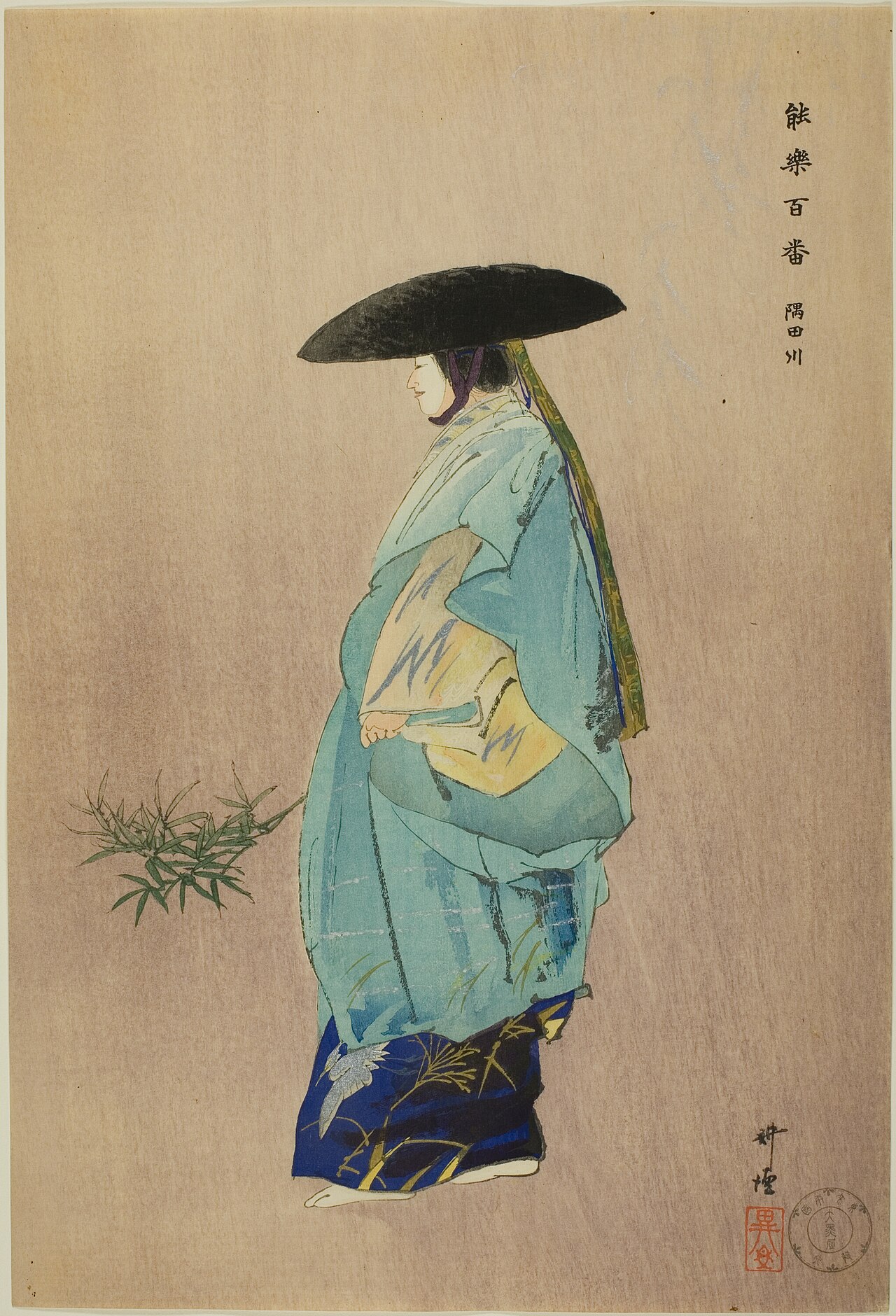
The mother in Sumidagawa reaches a ferry while looking for her abducted child. Japan Arts Council’s introduction describes a boatman who initially hesitates to carry her, then responds to the grief she expresses through poetry. Across the river, a memorial is taking place for a boy who died a year earlier. Her search is about to become recognition. [SUM1]
This sequence invites a reading of the river as a boundary between two kinds of knowledge. Before the crossing, a missing person might still be found alive. After the boatman’s account, the mother confronts a story already completed without her. The journey has produced information, but information cannot deliver the homecoming that gave the journey its purpose. [SUM1]
What must be asked again
The Council’s performance guide attends closely to the mother’s questions. She asks the dead boy’s age and name, then his father’s name, even as she understands the answer. Her inability to leave the boat and her dependence on the boatman become visible actions. The guide also identifies the traveling hat she carries as a sign of her long search. [SUM2]
In this reading, repeated questions do not simply delay the plot. They expose the difference between hearing a fact and being able to live with it. Each detail makes the connection harder to refuse. A name, ordinarily a way of calling someone closer, now identifies an absence. The small theatrical actions allow recognition to arrive as a process rather than a single revelation. [SUM2]
The loss has a human cause
Another Council resource explains the story’s trafficking background: the boy becomes ill while being taken toward the northeast and is abandoned by the river. Its historical discussion places child trafficking within conditions including poverty and famine. These are contextual explanations supplied by the institution; they do not independently establish the biography of a particular historical child. [SUM3]
Keeping that background visible changes the ethical weight of the haunting. My interpretation is that the ghost should not absorb all attention away from the human acts that precede it. The extraordinary meeting follows an ordinary vulnerability: a child can be removed from the people who care for him. The supernatural scene gives this separation a theatrical form without undoing its cause. [SUM3]
A figure, a voice, an empty space
Japan Arts Council documents several staging possibilities for the final encounter: the child may appear from the grave structure, be heard without appearing, or not be brought onstage. These alternatives matter. The mother’s gesture toward a visible figure is different from an audience listening for someone it cannot see, although both can make the failure of contact painfully legible. [SUM2]
The Council’s separate account of the opening describes the child performer concealed inside a willow-topped grave structure before the ferry scene unfolds. That arrangement suggests a striking reading: the ending is materially present while the mother still hopes. The audience’s space contains what her knowledge has not reached. Theatre can hold those unequal times together; it cannot make them resolve into reunion. [SUM4]
Sources and original texts
Original cultural readings of folklore, fiction and artistic representations. Interpretations are distinguished from source descriptions. Access to a collection record does not grant permission to reproduce its images or text. No supernatural event is verified.
- 隅田川 — 芸能への誘い — Japan Arts Council. Checked 2026-10-15.
- 隅田川 — 演出のポイント — Japan Arts Council, Cultural Digital Library. Checked 2026-10-15.
- 隅田川をひもとく — 中世の人買い — Japan Arts Council, Cultural Digital Library. Checked 2026-10-15.
- 隅田川を鑑賞する — その一 隅田川 春の渡し — Japan Arts Council, Cultural Digital Library. Checked 2026-10-15.
Original English cultural analysis. Institutional source descriptions are paraphrased, and interpretive conclusions are identified as readings. No source prose is reproduced. One image (Tsukioka Kōgyo's Noh illustration of Sumidagawa) is reproduced from Wikimedia Commons in the public domain and credited with the image.