GIZUMO JAPANESE OCCULT · FOLKLORE & PERFORMANCE
Matsukaze: A Shore Remembered by Two Sisters
Matsukaze and Murasame make a coastal haunting a shared memory, even when one sister commands the dance.
Existing subject: Ghost stories · Narrative: folklore · Spoilers: plot-spoilers
Content note: Bereavement, intense longing, and theatrical ghosts.
Japanese noh; Suma coast, Ariwara no Yukihira traditions, and a documented kabuki-dance adaptation.
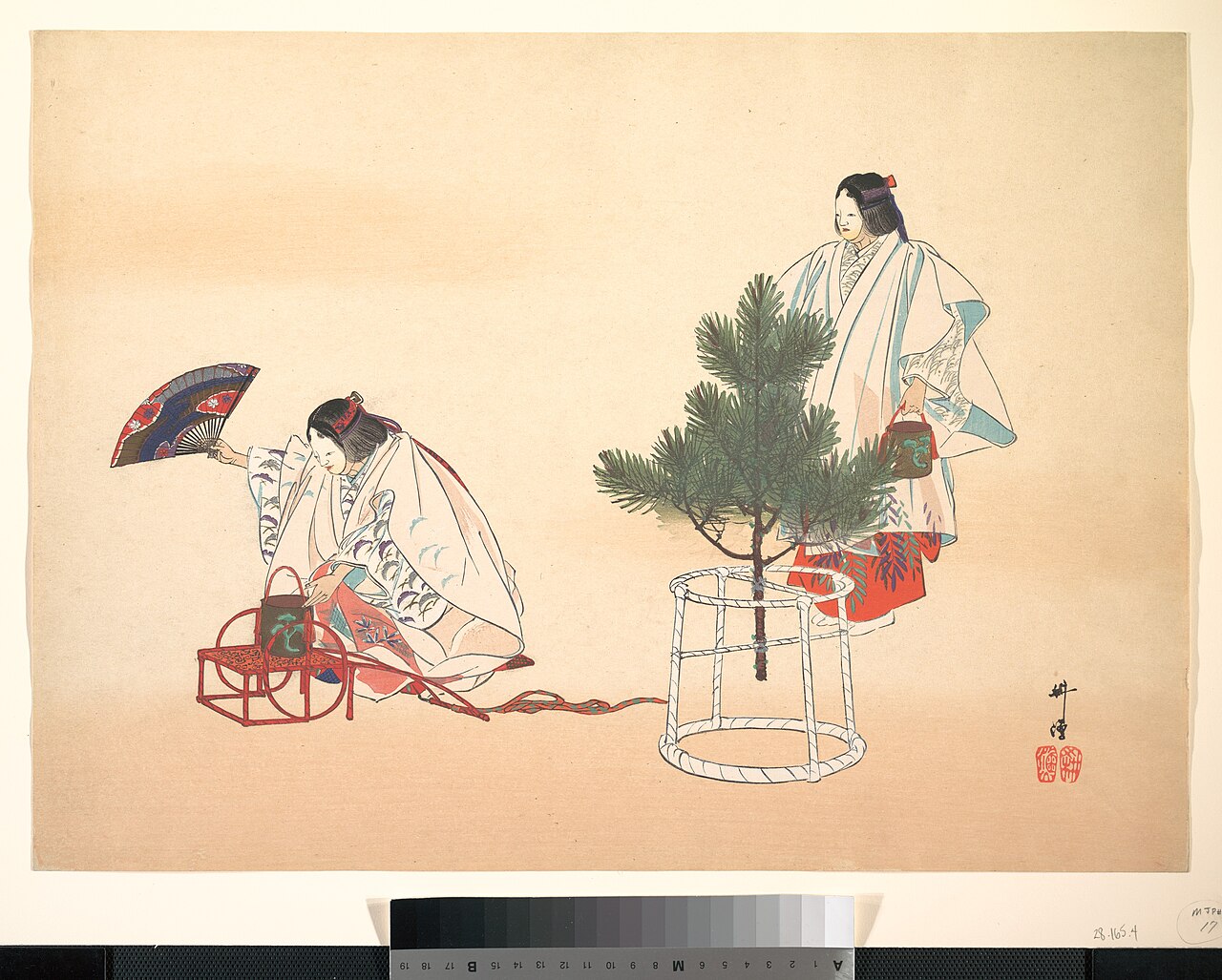
Why are there two?
Matsukaze takes its title from one woman, but its shore is remembered by two. The Nohgaku Performers' Association introduces Matsukaze and Murasame together, encountered by a traveling monk at Suma. Their connection to Ariwara no Yukihira emerges through recollection, while Matsukaze's mounting emotion becomes the focus of the dance. The unequal distribution of attention invites a question: what does the second sister make possible? [MAT1]
One interpretation is that a shared past becomes harder to dismiss when another person remains beside its speaker. A solitary lover might appear enclosed within private feeling. Two sisters give grief a relationship of its own. They belong to the same remembered world, yet the title and the central dance do not make their experiences interchangeable. Togetherness need not mean identical sorrow. [MAT1]
A coast of work and attachment
Japan Arts Council's account of the related kabuki dance Shiokumi describes the noh source as the sisters' ghosts drawing seawater beneath an autumn moon. The work of the shore therefore belongs to the remembered scene alongside love. In the kabuki adaptation, the cast is reduced to Matsukaze alone, a useful reminder that retaining two women is a meaningful theatrical choice. [MAT2]
This comparison does not make one version more authentic in feeling. It changes the question an audience can ask. With one woman, we watch an individual's remembrance. With two, we can also watch the space between people who remember. The sea becomes a place of repeated activity and companionship, rather than merely an attractive background for a nobleman's visit. [MAT2]
The keepsake and the tree
The National Noh Theatre's 2026 introduction describes Yukihira's departure for the capital and the cap and robe he leaves behind. Matsukaze eventually wears the keepsakes. It also explains that the Mitome performance variation adds a final gesture of looking toward the pine, emphasizing her projection of Yukihira's appearance onto it. That particular gesture should not be presented as universal staging. [MAT3]
Read together, costume and tree supply different kinds of persistence. A garment survives because someone keeps it. A tree continues growing without promising to remember anyone. The theatrical encounter makes these unequal forms of survival answer the same longing. From this perspective, the unsettling thing is how readily an enduring object can become the address of an absent person. [MAT3]
Listening after disappearance
A National Noh Theatre discussion among performers documents differing schools, masks, and special staging choices for Matsukaze. It also preserves actors' recollections of playing Murasame before taking the leading role. The sister beside the central figure is therefore part of a living performance relationship, not simply a spare character in a literary synopsis. [MAT4]
My reading of the ending follows that relational emphasis. When the figures are gone, the surviving coastal atmosphere can seem charged by what has been shared there. Nothing requires us to claim that a real shore contains these ghosts. The play instead trains attention: a place heard after a story has been told is no longer heard innocently. Its apparent emptiness now includes two remembered lives. [MAT3]
Sources and original texts
Original cultural readings of folklore, fiction and artistic representations. Interpretations are distinguished from source descriptions. Access to a collection record does not grant permission to reproduce its images or text. No supernatural event is verified.
- 松風(まつかぜ) — The Nohgaku Performers' Association. Checked 2026-10-15.
- 歌舞伎舞踊: 汐汲 — Japan Arts Council, Cultural Digital Library. Checked 2026-10-15.
- National Noh Theatre April 2026 introductions: 松風 — Japan Arts Council, National Noh Theatre. Checked 2026-10-15.
- 能「松風」特別座談会, 24 August 2015 — Japan Arts Council, National Noh Theatre. Checked 2026-10-15.
Original English cultural analysis. Institutional source descriptions are paraphrased, and interpretive conclusions are identified as readings. No source prose is reproduced. One image (Tsukioka Kōgyo's Noh illustration of Matsukaze) is reproduced from Wikimedia Commons under CC0 and credited with the image.