GIZUMO JAPANESE OCCULT · FOLKLORE & PERFORMANCE
Izutsu: Whose Face Is in the Well?
A well, a remembered childhood, and a husband's clothes turn recognition into the central mystery of Izutsu.
Existing subject: Ghost stories · Narrative: folklore · Spoilers: plot-spoilers
Content note: Bereavement, marital separation, and a theatrical ghost.
Japanese noh; the literary world of The Tales of Ise and the Isonokami setting in present-day Tenri.
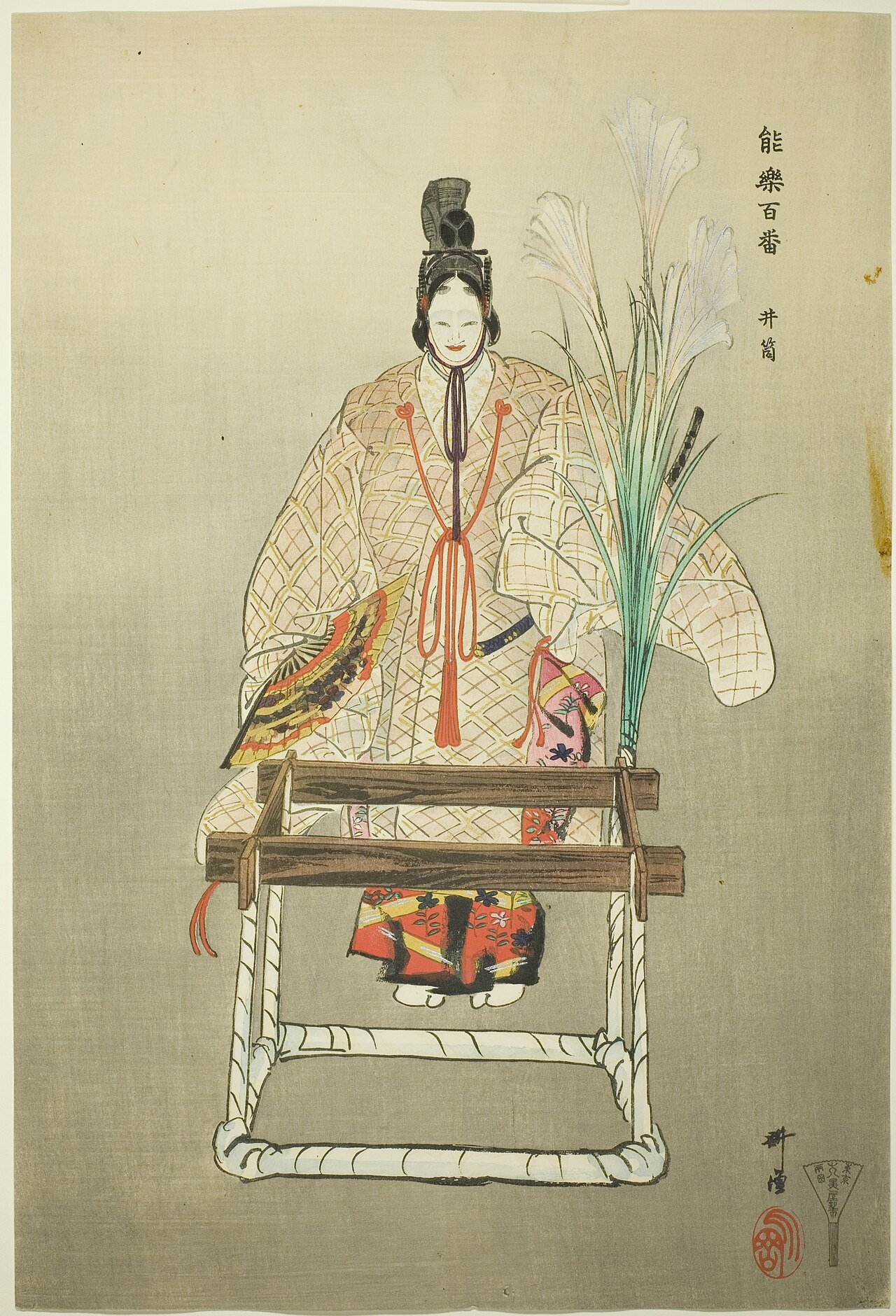
A measure that cannot hold time
The well in Izutsu once measured a difference that was easy to see: how tall two children had grown. Japan Arts Council identifies their exchanged childhood poems in The Tales of Ise as a foundation of the play. Years later, its water presents a harder question. When a woman wears the clothes of someone she longs for and looks down, whose presence does she recognize? [IZU1]
This essay reads the well as a changing instrument of recognition. A height mark records growth by holding one measurement still while the body moves beyond it. A reflection does almost the opposite: it changes with the person standing above it. The same place can therefore stage two conflicting wishes, to preserve the past exactly and to make it appear alive again. [IZU1]
Clothing without a returned body
The Nohgaku Performers' Association describes the visitor encountered by a traveling monk as a woman who recounts Narihira's relationship with Ki no Aritsune's daughter. She later appears dressed as Narihira and dances in remembrance. The absent husband is thus made visible through what the woman wears, rather than through an arriving actor who simply plays him. [IZU2]
That distinction creates an intimate theatrical puzzle. Clothing keeps the outline of a social identity available after its wearer is gone. Here, however, another person's body supplies its movement. In this reading, the costume neither erases the woman nor restores the man intact. It lets the audience hold them together for a moment, while continuing to know that togetherness is precarious. [IZU2]
The past moves backward
Japan Arts Council's performance guide points out that the woman's account moves backward: from the couple's married life and the husband's visits to Takayasu, toward their childhood courtship beside the well. The quiet dance called jo-no-mai follows. This is an arrangement of memory, not a biography unfolding evenly from youth to age. [IZU3]
Read in that order, returning to childhood is more than decorative nostalgia. The story travels toward a time before the relationship acquired its adult complications. Yet the movement cannot make the woman a child again. She brings everything that happened afterward to the remembered place. What looks like recovery can also disclose the distance between an early promise and the life that followed. [IZU3]
Looking is the event
The documented staging concentrates attention on a small action: the spirit brushes aside pampas grass and peers into the well while wearing Narihira's keepsakes. The water is understood as a mirror in which her figure and his remembered appearance overlap. Grass, clothing, and a downward look carry the scene's emotional work. [IZU3]
The haunting can consequently be read without treating the stage as evidence of a real apparition. Its unsettling force lies in recognition that depends on resemblance rather than reunion. She must occupy the beloved's outline to glimpse him. The well offers an image, but an image cannot look back with an independent life. That gap is where this interpretation locates the play's grief. [IZU1]
Sources and original texts
Original cultural readings of folklore, fiction and artistic representations. Interpretations are distinguished from source descriptions. Access to a collection record does not grant permission to reproduce its images or text. No supernatural event is verified.
- Izutsu (The Well Curb), Invitation to Nohgaku — Japan Arts Council. Checked 2026-10-15.
- 井筒(いづつ) — The Nohgaku Performers' Association. Checked 2026-10-15.
- 能の鑑賞「井筒」: 演出のポイント — Japan Arts Council, Cultural Digital Library. Checked 2026-10-15.
Original English cultural analysis. Institutional source descriptions are paraphrased, and interpretive conclusions are identified as readings. No source prose is reproduced. One image (Tsukioka Kōgyo's Noh illustration of Izutsu) is reproduced from Wikimedia Commons in the public domain and credited with the image.