GIZUMO JAPANESE OCCULT · FOLKLORE & PERFORMANCE
Rokurokubi: What a Long Neck Lets an Artist Do
Rokurokubi crosses between extended necks, flying heads, and pictorial jokes. Reading specific sources reveals why one fixed monster profile is inadequate.
Existing subject: Yōkai · Narrative: folklore · Spoilers: premise-only
Content note: Imaginary bodily distortion, detached heads, and a non-graphic threat of being eaten.
Japanese Edo-period yōkai pictures and the documented literary source for Lafcadio Hearn’s 1904 retelling; variation is kept specific to named works.
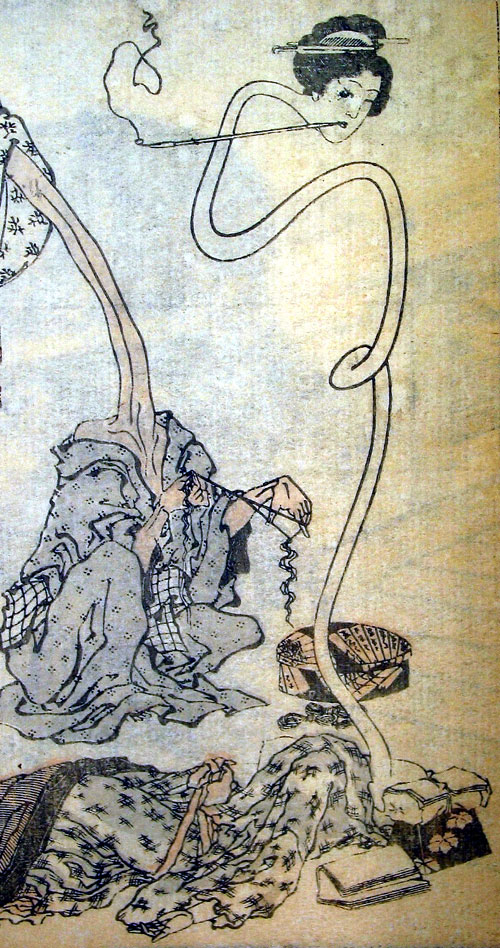
One name does not settle the anatomy
A long, stretching neck is a familiar way to recognize rokurokubi, but the Lafcadio Hearn Memorial Museum makes an important distinction. Hearn’s 1904 story presents heads that separate from their bodies and fly. The museum identifies its source in the fourth volume of Jippensha Ikku’s Kaibutsu Yoron, published in 1803, and says the retelling follows that source closely. It also notes Hearn’s humorous drawing of the elongated-neck form in Japanese Goblin Poetry. [RO1]
This essay reads the coexistence of those forms as a reason to begin with a work, rather than enforce a single creature profile. The anatomical difference changes the imaginative problem: stretching preserves a connection, while separation makes the head independently mobile. We need not explain the difference away or treat Hearn as a transparent recorder of an anonymous national belief. His named retelling and its identifiable predecessor offer a more precise route into cultural history, with publication and adaptation kept visible. [RO1]
An attribute can travel between beings
The National Diet Library compares long-necked figures by Toriyama Sekien, Utagawa Toyokuni, and Tsukioka Yoshitoshi. It identifies the first two artists’ examples as women. Yoshitoshi’s basket-emerging figure, however, is the giant monk Mikoshi-nyūdō, whom the library explicitly distinguishes from rokurokubi even as it discusses the stretched neck. Its explanation links the exaggeration to the monk’s habit of looking down on others. The shared feature does not make the figures identical. [RO2]
In our interpretation, this is a particularly useful lesson in reading yōkai art. Anatomy can function as a pictorial device as well as an identifying attribute. A lengthened neck can connect distant parts of an image, alter a figure’s relation to surrounding bodies, or make a social attitude conspicuous. Those possibilities are analytical suggestions, not a universal definition. When a resemblance tempts us to merge two names, the better question is what that resemblance accomplishes in the particular composition. [RO2]
When a proverb acquires a body
A Kyōsai colour woodcut in the Library of Congress brings Rokurokubi and Mikoshi-nyūdō together around a noodle-shop customer. The catalogue tentatively dates it to 1863 and identifies it with a proverb about yielding to whatever is long. Its exhibition commentary describes the customer bound by the creatures and their open mouths suggesting that he may become their meal. The record preserves uncertainty about the date and distinguishes that implied outcome from an event actually shown. [RO3]
Our reading is that the exaggerated bodies make the proverb actionable inside the picture. Length becomes a means of restraint, while the meal setting adds a reversal of who might consume whom. A monster image can thus be alarming and verbally playful at once. Read across these examples, rokurokubi offers more than a memorable silhouette. The changing neck and head help artists and writers organize distance, domination, humour, and uncertainty, with each work asking for its own careful identification. [RO3]
Sources and original texts
Original cultural readings of folklore, fiction and artistic representations. Interpretations are distinguished from source descriptions. Access to a collection record does not grant permission to reproduce its images or text. No supernatural event is verified.
- Lafcadio Hearn: Visions of the Supernatural — Lafcadio Hearn Memorial Museum. Checked 2026-10-15.
- TORIYAMA Sekien’s Illustrated Night Parade of the Demon Horde: Rokurokubi — National Diet Library. Checked 2026-10-15.
- Two long-necked creatures accosting a noodle shop customer — Library of Congress. Checked 2026-10-15.
Original English cultural analysis. Institutional source descriptions are paraphrased, and interpretive conclusions are identified as readings. No source prose is reproduced. One image (Katsushika Hokusai's rokurokubi) is reproduced from Wikimedia Commons in the public domain and credited with the image.