GIZUMO JAPANESE OCCULT · FOLKLORE & PERFORMANCE
What Does a Tengu’s Face Ask Us to Recognize?
An armored mask, a shrine-dance type, a medieval scroll and a stage image assign different roles to the same supernatural figure.
Selected Japanese tengu representations described by their holding institutions and a university collection exhibition.
Content note: Includes brief fictional plot details; no supernatural event is presented as verified.
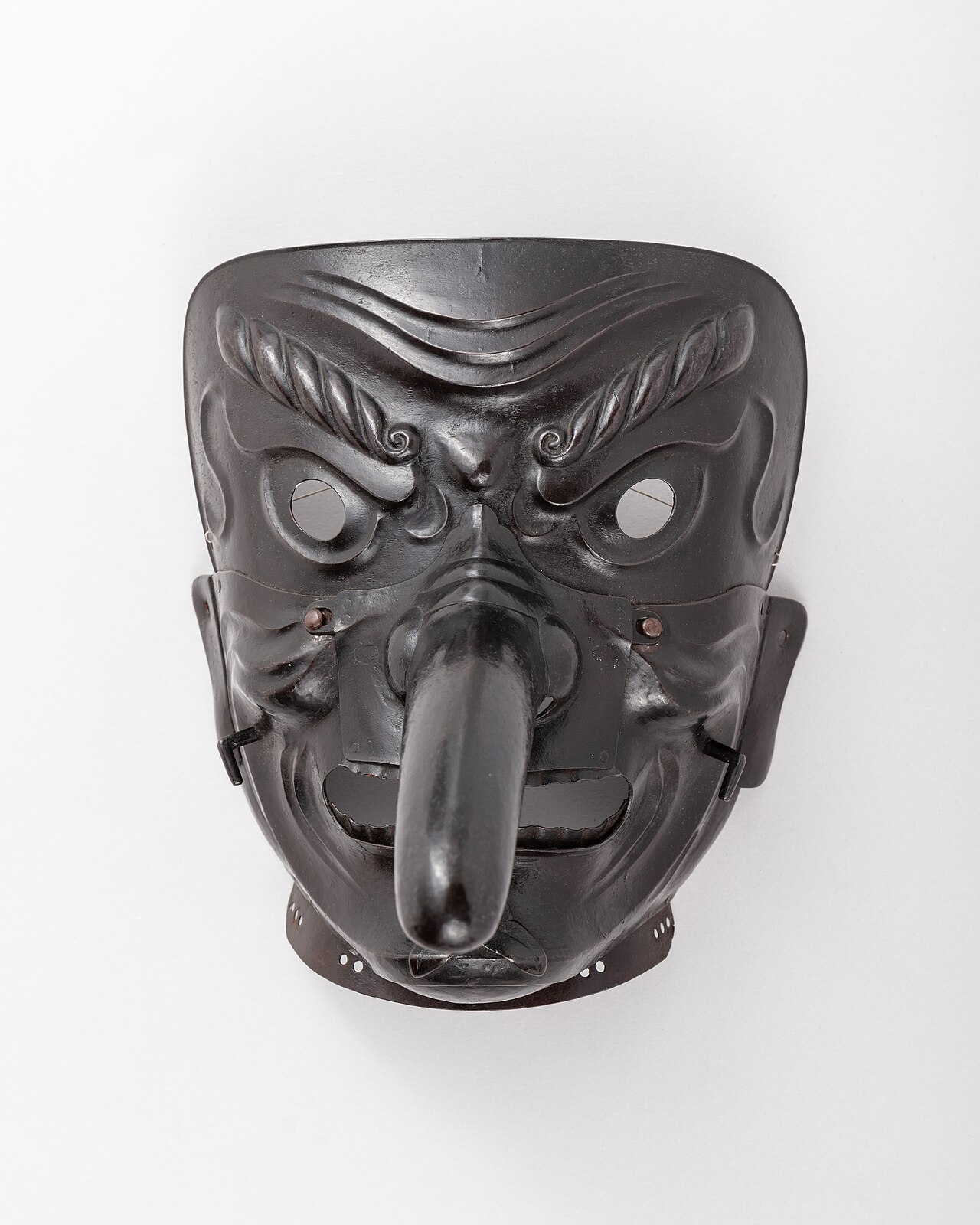
A long nose becomes a surface of armor
An early eighteenth-century mask at the Metropolitan Museum of Art gives a tengu’s long nose a body of embossed, lacquered iron. It is a sōmen, covering the whole face. The museum places it among Edo-period armorers’ imaginative designs and distinguishes the human-faced, long-nosed tengu from the beaked, bird-headed form. Here the creature’s identity is built into an object made to fit a person, turning a supernatural face into something physically wearable. [1]
The museum connects tengu with stories of exceptional skill in weapons and with mountain ascetics called yamabushi. Those associations give an armored version a particular charge. Our reading is that the face can suggest formidable ability before any narrative is told. That does not establish how this individual mask was worn or how an opponent reacted to it. Its material and classification provide the firmer evidence: an armorer selected a recognizable supernatural identity and translated it into the construction of a face-covering. [1]
Religious clothing does not settle the character
A seventeenth-century wooden mask in the Smithsonian’s National Museum of Asian Art has a red face and a long nose. The catalogue identifies wood, pigment and lacquer, and relates masks of this tengu type to shrine dances. Where the iron example belongs to armor, this institutional account places the red face within performance. The shared outline does not mean the two objects had the same occasion, wearer or purpose. [2]
The Smithsonian label also points to a tension in the figure’s religious appearance. Tengu often wear yamabushi garments in representations, yet stories describe them tormenting Buddhist priests. Clothing alone is therefore an unreliable moral label. A figure can borrow a recognizable religious appearance while unsettling the authority associated with it. This is an interpretation of the juxtaposition in the museum’s account, rather than a claim that every dance expressed hostility to Buddhism. The mask supplies a type of face; the surrounding story or action gives that face a role. [2]
A title can promise more monsters than a scroll shows
The National Institutes for Cultural Heritage describes Tengu zōshi as a narrative satirizing the pride and misconduct of Buddhist clergy through comparisons with tengu. Its account then adds an important qualification about the two thirteenth-century scrolls in Tokyo National Museum. These particular sections largely present temple histories and buildings. Only a few tengu appear among the mountains and structures in the Enryakuji section; the museum says that overtly satirical scenes are absent from these holdings. [3]
That difference changes how the title should guide attention. A reader expecting a parade of prominent creatures could overlook architecture and institutional history that occupy the actual paintings. The title identifies a wider narrative project, while the surviving sections offer their own visual emphasis. Here the tengu can be a comparatively small presence within a larger religious landscape. Its importance need not correspond to the amount of painted space it occupies, and the general description of a work should not stand in for its particular surviving parts. [3]
The stage has another face available
The University of Oregon’s collection exhibition discusses a Tsukioka Kōgyo diptych showing the tengu of Mount Kurama on the Noh stage. Its description identifies a mature performer in a red wig and a beshimi mask: a grimacing, bearded face closer to human form than the familiar long-nosed design. A child performer represents the young Yoshitsune, carrying a halberd. The adult’s feather fan adds another recognizable element to the tengu’s stage appearance. [4]
This gives the editorial question a concrete answer. A tengu need not retain one conspicuous feature to remain legible within a particular setting. The theatrical combination includes mask, wig, costume, prop and another character, so recognition can be shared across the scene. The university’s description concerns a print of performance, not direct documentation of a supernatural being. Read alongside other kinds of objects, it suggests that changes of face are purposeful choices: representations equip tengu for armor, dance, religious narrative or a dramatic encounter, each with its own demands. [4]
Official sources
Sources were checked on 2026-10-15. These features interpret Japanese folklore and performance from institutional research. Fictional events and attributed beliefs are distinguished from historical evidence. One image (the Metropolitan Museum's tengu sōmen (full-face mask)) is reproduced from Wikimedia Commons under CC0 and credited with the image.
- Mask in the Shape of a Mountain Demon’s Face, 36.25.263a, b — The Metropolitan Museum of Art. Checked 2026-10-15.
- Demon mask, F2003.5.15 — Smithsonian National Museum of Asian Art. Checked 2026-10-15.
- 天狗草紙絵巻, Tokyo National Museum holdings — National Institutes for Cultural Heritage, e-Museum. Checked 2026-10-15.
- Yōkai Senjafuda: Tengu — University of Oregon Libraries and Jordan Schnitzer Museum of Art. Checked 2026-10-15.