GIZUMO JAPANESE OCCULT · FOLKLORE & PERFORMANCE
How Does Kabuki Turn a Cat into a Stage Mystery?
Familiar gestures, family resemblance and an actor’s changes of role make the monster cat a problem of theatrical recognition.
Historical Kabuki cat-spirit imagery and specific production descriptions from museums and Shochiku.
Content note: Includes brief fictional plot details; no supernatural event is presented as verified.
A strange gesture can change a familiar body
Shizuoka City Museum of Art’s exhibition on cats describes a revealing stage image: an old woman licking lamp oil at night. It attributes this formulation to the playwright Tsuruya Nanboku IV and connects it with Onoe Kikugorō III’s celebrated cat-spirit performance in 1827. The museum places it among earlier associations involving dancing cats, female figures and cats possessing old women. A theatrical monster could emerge by concentrating recognizable motifs into a particular action. [1]
The lamp-oil gesture makes that process easy to grasp. The performer can still present a human figure while doing something that changes how the figure is understood. Our reading is that the scene’s interest lies in recognition arriving unevenly: the visible person and the suspected identity no longer agree. The museum also situates monster cats in late Edo revenge narratives on stage and in illustrated books. Their dramatic force thus involves relationships and grievances, as well as an extraordinary appearance. The cat belongs to a story’s human troubles. [1]
Transformation is also a performer’s task
Shochiku’s account of its 2009 Arima Neko production gives transformation another meaning. It recalls Bandō Takesaburō’s 1965 appearance, under his earlier stage name, when he performed four roles with quick changes. For the 2009 production, it lists three roles for him, including the servant Onaka and Onaka revealed as a monster cat. The account supplies a practical theatrical counterpart to the fiction’s unstable identities: one actor must make several appearances distinct. [2]
That relationship encourages a double reading. Inside the story, a person’s identity can conceal something frightening. In the production record, the change also belongs to a performer’s repertoire. Knowing that roles share an actor need not remove the narrative’s uncertainty; it offers another thing to notice about how an appearance is made. Shochiku identifies the work with Kawatake Mokuami and the title Arimatsu-zome Sumō Yukata. These particular production details keep the discussion tied to a named work, rather than treating every Japanese monster-cat story as one play. [2]
Family resemblance becomes part of the trap
The premise of Tabi no Uwasa Okazaki no Neko, described by Shochiku for its December 2023 Kabukiza programme, begins with a family seeking a night’s shelter at Muryōji. The old woman Osan, who looks after the temple, resembles Osode’s mother, believed to have died. Her apparent delight at meeting a first grandchild makes the encounter look intimate. The production description then identifies the old woman as a terrifying cat spirit. [3]
This premise gives the disguise more than an outward shape. It borrows a place in a family and an expected emotional response. Our reading is that recognition itself becomes vulnerable: resemblance invites trust while concealing the scene’s threat. Shochiku also describes the cat’s appearance in jūnihitoe court dress, adding an extravagant costume image to the domestic deception. These are features of this production’s published account. Together they show how a monster cat can move from an apparently familiar face to a conspicuously theatrical presence without needing to resemble an ordinary animal. [3]
A print is not a stage transcript
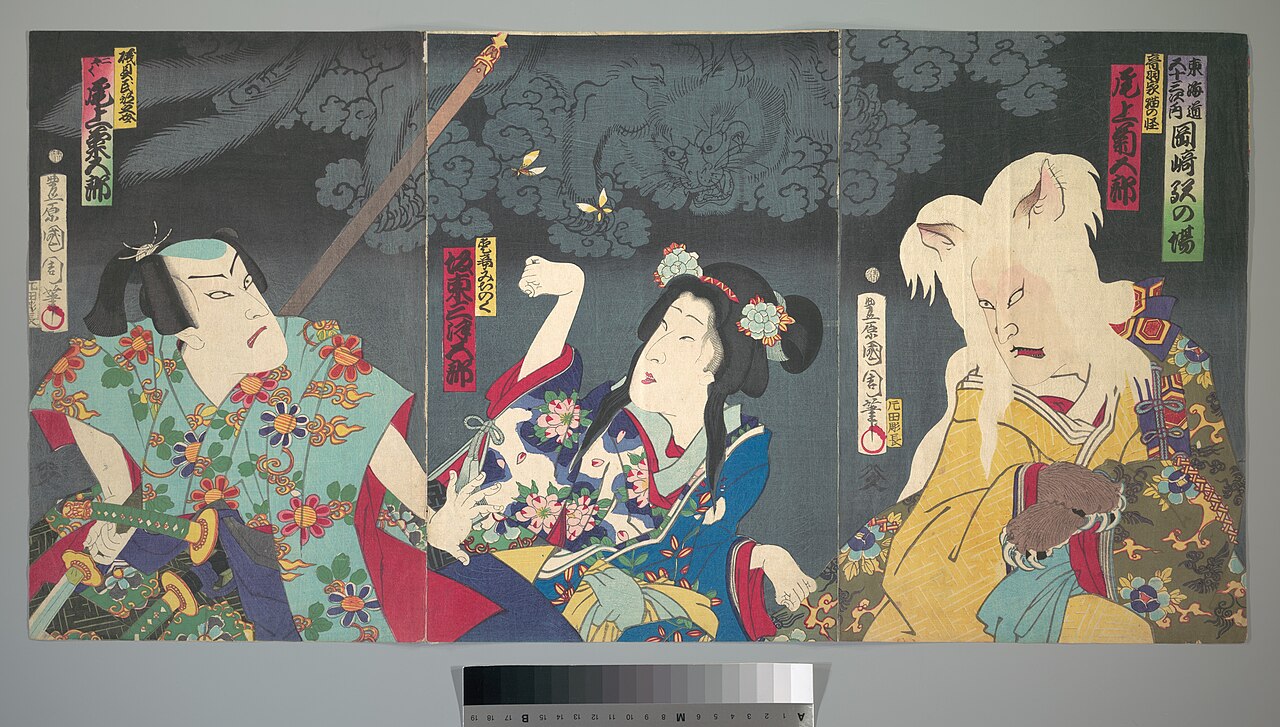
A Kunisada triptych discussed by the Fitzwilliam Museum relates to a Tōkaidō play containing a giant cat-spirit episode at Okazaki. The museum notes that the role labels beside the actors differ from their stage roles. It reads this mismatch as evidence of advance publicity. However, its page dates the print to 1838 while linking it to an 1835 performance, so this article does not adopt that implied publication chronology as settled fact. [4]
The firmer distinction is between a printed representation and a performance record. The museum describes a play assembled from episodes connected with stations along the Tōkaidō, including apparitions. A monster cat could supply one striking encounter within a larger journey. Our reading keeps those layers separate: an actor’s name, a printed role label and a dramatic episode do not automatically document the same event. Comparing them makes the work of presenting the cat visible without requiring a doubtful timeline to explain it. [4]
Official sources
Sources were checked on 2026-10-15. These features interpret Japanese folklore and performance from institutional research. Fictional events and attributed beliefs are distinguished from historical evidence. One image (Toyohara Kunichika's kabuki print of the monster-cat play Nekomata Yashiki) is reproduced from Wikimedia Commons under CC0 and credited with the image.
- いつだって猫展: 第2章 化ける猫 — Shizuoka City Museum of Art. Checked 2026-10-15.
- 坂東竹三郎の世界: 怪異 有馬猫, 2009 — Shochiku, Kabuki-bito. Checked 2026-10-15.
- 十二月大歌舞伎: 旅噂岡崎猫, December 2023 — Shochiku, Kabuki-bito. Checked 2026-10-15.
- Tokaido, Kunisada & Kabuki exhibition — The Fitzwilliam Museum, University of Cambridge. Checked 2026-10-15.