GIZUMO JAPANESE OCCULT · FOLKLORE & PERFORMANCE
Nurikabe: A Wall Without One Shape
A blocked night road, changing regional names, and an unexpected painted creature complicate the idea of a single nurikabe.
Existing subject: Yōkai · Narrative: folklore · Spoilers: premise-only
Content note: Nighttime disorientation and supernatural obstruction, discussed as recorded folklore.
Selected Fukuoka and Ōita folklore records, the BYU Bakemono no e scroll, and Mizuki Shigeru’s modern representation.
The road that refuses passage
A road need not acquire a visible monster to become frightening. Nichibun’s database summarizes a record from Fukuoka’s Onga district in which a night walker suddenly finds the way blocked as though by a wall. The obstruction is called nurikabe. Brushing its lower part with a stick is said to remove it, while striking higher up accomplishes nothing. [NUR1]
The account offers almost no anatomy, yet supplies a precise relationship between body and obstacle. Feet must continue forward; an unseen boundary refuses them. In this reading, the lower stroke matters because it makes the problem practical and local. The traveler is given a small action to attempt, rather than an elaborate explanation of what kind of being occupies the road. [NUR1]
Names beside the path
Two Nichibun summaries drawn from Ōita Prefecture’s 1986 folklore history preserve different local wording. Usuki uses kabenuri for nurikabe. A Kakaji account calls a sudden loss of forward vision itachi no nurikabe, a name associating the obstruction with a weasel. These are short database abstracts of identified records, not complete transcripts of every story told in either place. [NUR2] [NUR3]
The changed names resist the convenience of a single illustrated species. One version emphasizes a wall; another adds an animal association. My interpretation is that the unstable naming keeps attention on what happens to the traveler. An interruption can remain recognizable while its imagined agent changes. The evidence supports related local descriptions, without requiring us to fuse all of them into one origin story. [NUR2] [NUR3]
A picture complicates recognition
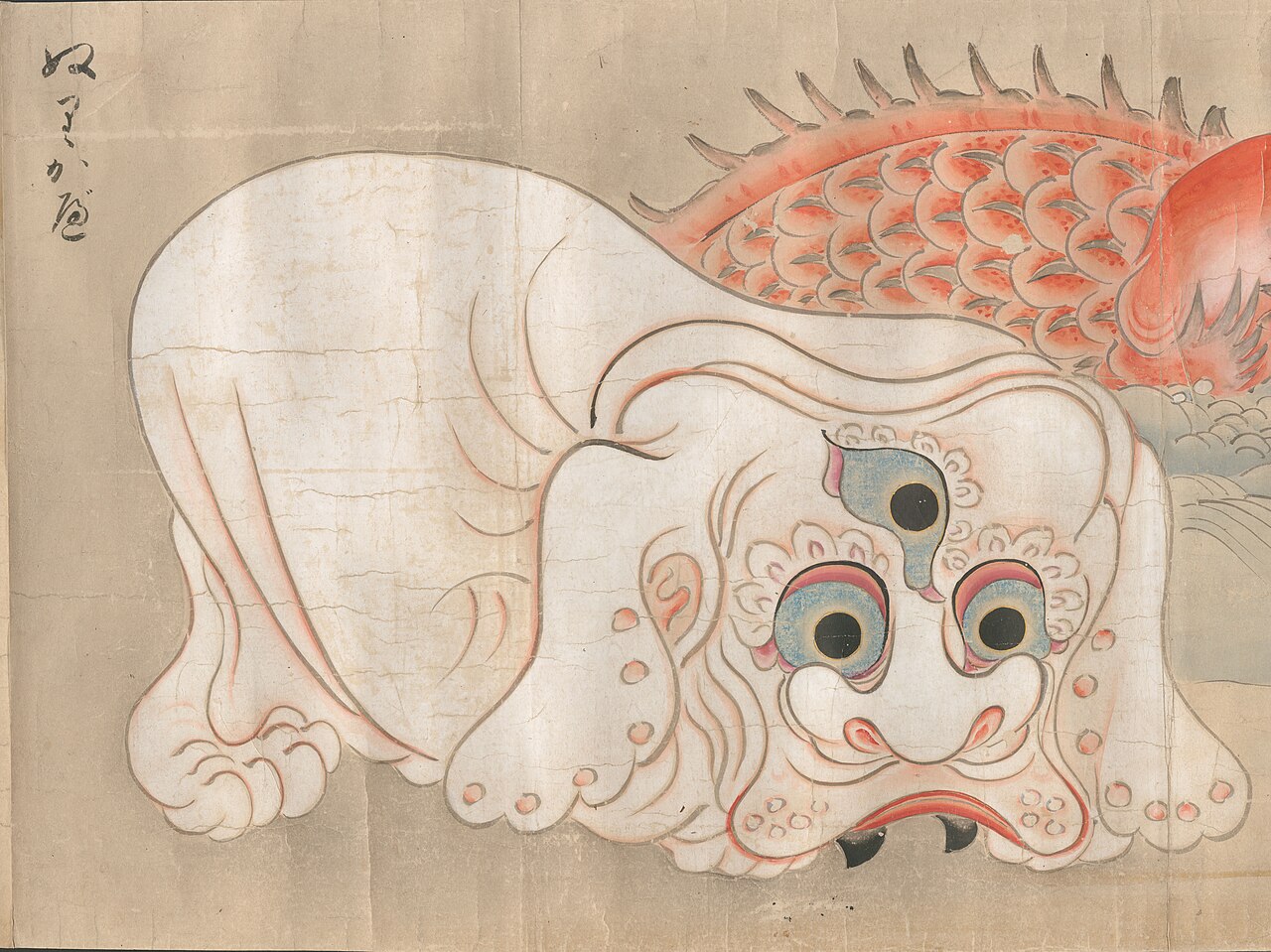
BYU Library’s Bakemono no e project presents a painted figure labeled nurikabe that looks nothing like an ordinary wall: a pale, four-legged creature with three eyes and dark fangs. Jack Stoneman’s accompanying discussion explains that scholars disagree over whether this scroll figure and the Kyushu folklore phenomenon should be treated as the same yōkai. A matching name does not settle the identification. [NUR4]
That uncertainty is productive. Read as an image, the creature has a body available for close inspection; read as a roadside account, nurikabe is an experience of being unable to proceed. Neither format automatically explains the other. Their juxtaposition exposes a habit of the viewer: once we recognize a familiar label, we may expect a continuity the surviving evidence cannot guarantee. [NUR4]
A companion on a public street
The Mizuki Shigeru Museum’s road guide identifies nurikabe with Onga district while also describing it as Kitarō’s companion in GeGeGe no Kitarō. The museum’s separate road overview presents the bronze sculptures as part of a walking route through Sakaiminato. A named obstruction has consequently also become a figure visitors can seek out during an organized cultural walk. [NUR5] [NUR6]
This modern setting invites a final reversal. Within the older summarized story, the encounter interrupts a journey; on the museum’s route, finding the figure helps give a journey its purpose. That is an interpretation of the change in setting, not a claim that popular art erased earlier traditions. Nurikabe can remain an obstacle in one account and become welcome company in another. [NUR5] [NUR6]
Sources and original texts
Original cultural readings of folklore, fiction and artistic representations. Interpretations are distinguished from source descriptions. Access to a collection record does not grant permission to reproduce its images or text. No supernatural event is verified.
- 塗り壁, record 2180774 — International Research Center for Japanese Studies (Nichibun). Checked 2026-10-15.
- 塗り壁・壁塗り, record C4410033-000 — International Research Center for Japanese Studies (Nichibun). Checked 2026-10-15.
- イタチの塗り壁, record C4410031-000 — International Research Center for Japanese Studies (Nichibun). Checked 2026-10-15.
- Nurikabe, BYU Bakemono — Brigham Young University, Harold B. Lee Library. Checked 2026-10-15.
- 身近なところにひそむ妖怪たち: 104. ぬりかべ — Mizuki Shigeru Museum. Checked 2026-10-15.
- 水木しげるロード — Mizuki Shigeru Museum. Checked 2026-10-15.
Original English cultural analysis. Institutional source descriptions are paraphrased, and interpretive conclusions are identified as readings. No source prose is reproduced. One image (the nurikabe from the Bakemono no e scroll) is reproduced from Wikimedia Commons in the public domain and credited with the image.