GIZUMO JAPANESE OCCULT · FOLKLORE & PERFORMANCE
Hitotsume-kozō: The Visitor Who Keeps a Ledger
Baskets, household chores, and a disappearing notebook give a one-eyed visitor a place in Kanagawa’s seasonal calendar.
Existing subject: Yōkai · Narrative: folklore · Spoilers: plot-spoilers
Content note: Traditional fears of illness and child abduction; supernatural beliefs discussed as folklore.
Selected Kanagawa traditions of hitotsume-kozō, especially Isehara, Sagamihara, Ebina, and Yamato; not a universal Japanese custom.
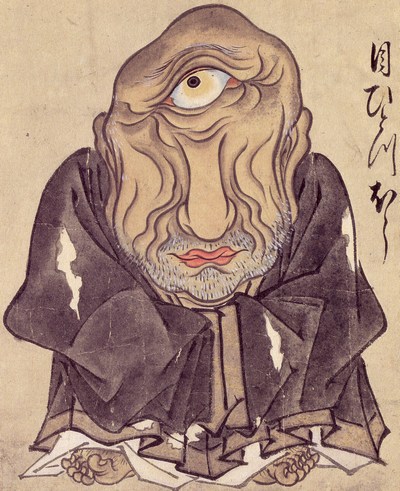
A visitor with an appointment
An unexpected monster can appear at any moment. The hitotsume-kozō of certain Kanagawa seasonal traditions is more unsettlingly punctual. Isehara’s cultural-property account places the feared one-eyed visitor on the night of February 8. Children were warned that it could carry them away or make them ill. The household prepared for its arrival with baskets, offerings, and a particular evening meal. [HIT1]
This local account suggests a useful way to read the figure: as an appointment that changes ordinary behavior before anything appears. Anticipation gives the story its reach. A child need not encounter a strange face for the evening to feel different. The meal, the preparations, and the expectation of inspection have already brought the visitor into the household’s imagination. [HIT1]
The household looks back
Sagamihara City Museum documents baskets and sieves displayed because their numerous openings were understood as eyes that would frighten the single-eyed visitor. Its photographs include a potato-washing basket raised on a bamboo pole in 1989 and a household displaying both a basket and a newer sieve in 2012. The account connects the practice with December 8 and February 8. [HIT2]
The striking detail is the newer sieve. In this reading, protection depends on recognizing a useful resemblance, rather than preserving one object unchanged. A kitchen implement can become a watchful face. Its many openings reverse the imbalance between an inspecting visitor and an exposed household: the house seems able to look back with more eyes than its unwelcome guest possesses. [HIT2]
An accusation needs a record
Ebina’s version gives the visitor a notebook. It records household lapses, including unsecured shutters, and leaves the book with a roadside Dōsojin deity until January 15. When it returns, the deity explains that the record was destroyed in the previous night’s fire. The story identifies that fire with the local burning of New Year decorations and other seasonal materials. [HIT3]
As a narrative device, the ledger makes misfortune administratively vulnerable. The visitor’s threatening knowledge has been transferred onto something that can burn. This interpretation does not turn the custom into evidence of supernatural protection. It notices the tale’s satisfying reversal: the same careful record-keeping that seems to make punishment unavoidable also gives the community a way to imagine escaping it. [HIT3]
Leave room for different calendars
Yamato’s exhibition sheet records a related account in which the notebook is collected on February 8, with its destruction associated with January 14’s Sēto-yaki fire. It also stresses that Koto-yōka traditions vary: some places welcome deities with offerings rather than anticipate this yōkai. Even neighboring versions should not be compressed into a single fixed schedule or meaning. [HIT4]
These differences make the visitor more interesting, not less coherent. Read together, the records show how a recognizable figure can organize different local relationships among danger, hospitality, and renewal. The one eye is memorable, but the surrounding arrangements matter just as much. A basket at an entrance and a notebook entrusted elsewhere locate the story in a community’s particular calendar. [HIT4]
Sources and original texts
Original cultural readings of folklore, fiction and artistic representations. Interpretations are distinguished from source descriptions. Access to a collection record does not grant permission to reproduce its images or text. No supernatural event is verified.
- 一つ目小僧: 歳時記 2月 — Isehara City, Cultural Properties. Checked 2026-10-15.
- 写真で見る相模原 No.37: 一つ目小僧がやってくる — Sagamihara City Museum. Checked 2026-10-15.
- 一つ目小僧 — Ebina City, Cultural Properties. Checked 2026-10-15.
- 年中行事展示解説シート 6: ヨーカゾーの目籠飾り — Yamato City cultural foundation, local-history exhibition materials. Checked 2026-10-15.
Original English cultural analysis. Institutional source descriptions are paraphrased, and interpretive conclusions are identified as readings. No source prose is reproduced. One image (Sawaki Sūshi's hitotsume-kozō (Mehitotsubō)) is reproduced from Wikimedia Commons in the public domain and credited with the image.