GIZUMO JAPANESE OCCULT · FOLKLORE & PERFORMANCE
Kasha: Keeping the Funeral in Human Hands
A fiery cart, a decoy coffin, and small protective actions reveal different ways of imagining danger around the dead.
Existing subject: Yōkai · Narrative: folklore · Spoilers: plot-spoilers
Content note: Death, funerals, threatened corpse theft and consumption, and Buddhist images of punishment.
Selected representations of kasha in a Japanese picture scroll and folklore records from Yamanashi, Ehime, and Miyazaki; historical beliefs, not funeral advice.
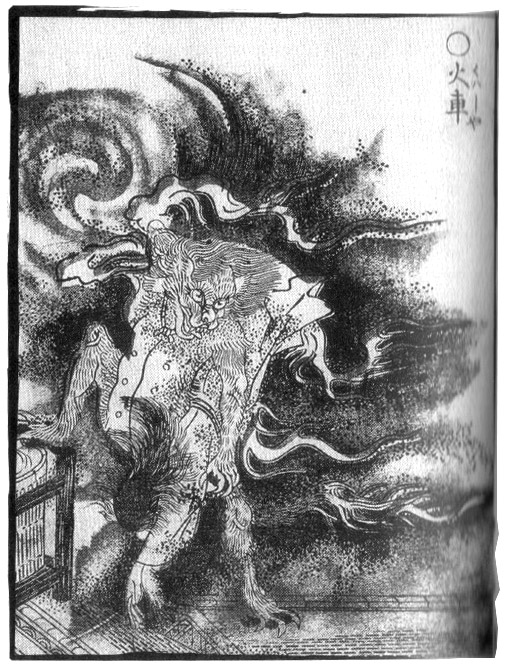
Who controls the departure?
A funeral is meant to carry the dead toward an agreed destination. Kasha introduces another claimant to that journey. BYU Library’s commentary on its Bakemono no e scroll describes a demon pulling a cart, connecting the name with fiery vehicles in Buddhist images of punishment. It also distinguishes this representation from familiar depictions of a catlike creature surrounded by flame. [KAS1]
The cart offers a particularly sharp image of interrupted custody. In this reading, movement itself becomes threatening: the dead may be taken somewhere their mourners never intended. The collection commentary connects such imagery with moral instruction, but that does not justify judging any actual deceased person. These are representations of feared consequences, and their meanings must remain attached to their particular narrative settings. [KAS1]
A coffin that buys time
A Yamanashi story summarized by Nichibun describes a kasha waiting to seize a corpse near a temple serving Shōji. A priest recognizes its deception and orders two funeral departures. The first coffin contains stones. When the creature snatches that decoy from beneath dark clouds, the family uses the interval to complete the second departure and convey the remains safely to the temple. [KAS2]
The victory depends on sequencing rather than superior force. The first procession supplies the appearance the attacker expects; the second carries what matters. Interpreted this way, the tale makes cooperation between priest and household the answer to predation. Its emotional satisfaction lies in finishing a duty despite interference, rather than displaying a hero who permanently abolishes every danger surrounding death. [KAS2]
A small object at the boundary
Nichibun’s abstract of an Ehime prefectural-history passage records a much smaller intervention in Yawatahama: a razor placed on the coffin was said to prevent kasha from taking the body. The summary does not explain why the object works. It preserves a belief and its associated action, without supplying an origin, a universal rule, or evidence that the practice remains current. [KAS3]
That restraint matters when reading protective customs. It would be easy to invent a complete symbolism for the blade, yet this brief record cannot establish one. What it does allow is an interpretation of placement. The object sits on the very container whose security is threatened, concentrating the story’s concern with protection at a specific boundary between the dead and the surrounding world. [KAS3]
Refusal spoken aloud
A university folklore-survey record from Miyazaki, published in 1965 and summarized in Nichibun’s database, describes a spoken refusal before the coffin departs: the dead will not be given to kasha to eat. The formula is repeated twice. Here the documented response is a voice asserting refusal at the moment of departure, rather than the Yamanashi tale’s elaborate substitution. [KAS4]
Read beside the decoy and the razor, that refusal suggests several scales of imagined agency: coordinated action, a carefully positioned object, and words. None establishes a single nationwide kasha ritual. Together, these limited records make another interpretation possible: stories of corpse theft also give the living ways to articulate their determination that the dead should remain within their care. [KAS4]
Sources and original texts
Original cultural readings of folklore, fiction and artistic representations. Interpretations are distinguished from source descriptions. Access to a collection record does not grant permission to reproduce its images or text. No supernatural event is verified.
- Kasha, BYU Bakemono — Brigham Young University, Harold B. Lee Library. Checked 2026-10-15.
- 火車, record 0450013 — International Research Center for Japanese Studies (Nichibun). Checked 2026-10-15.
- カシャ, record C3820125-000 — International Research Center for Japanese Studies (Nichibun). Checked 2026-10-15.
- バク・火車, record 2360804 — International Research Center for Japanese Studies (Nichibun). Checked 2026-10-15.
Original English cultural analysis. Institutional source descriptions are paraphrased, and interpretive conclusions are identified as readings. No source prose is reproduced. One image (Toriyama Sekien's kasha) is reproduced from Wikimedia Commons in the public domain and credited with the image.