GIZUMO JAPANESE OCCULT · FOLKLORE & PERFORMANCE
Nure-onna: Water, Images, and a Dangerous Request
Regional records and a printed game show how Nure-onna moves between a wet-haired stranger, a serpentine figure, and a troubling request for help.
Existing subject: Yōkai · Narrative: folklore · Spoilers: premise-only
Content note: Folkloric threats involving an infant-shaped object and blood-drinking; no graphic detail.
Nure-onna representations in Japanese print culture and recorded traditions of Aso, Kumamoto, and Iwami, Shimane.
Three records, three emphases
A figure among waves, a wet-haired presence beside a hot-spring settlement, and a stranger asking someone to hold a child: Nure-onna appears differently across the records. These are representations and reported beliefs, not evidence of a creature with a settled biology. Reading the differences carefully is more revealing than combining every feature into a single imagined encounter. [NU1] [NU2] [NU3]
A body designed for recognition
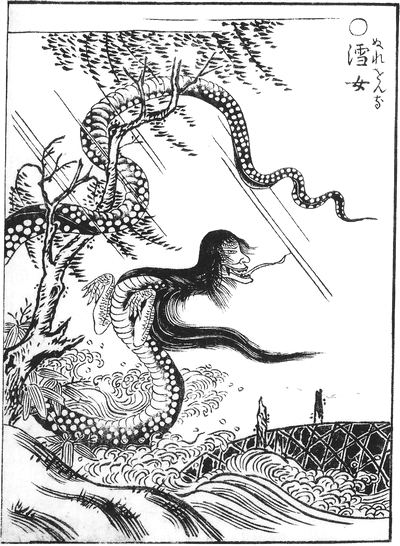
Nichibun’s image catalogue identifies a Nure-onna in Shinpan yokai tobimawari sugoroku, a printed sugoroku game. Its description emphasizes hanging hair, an extended tongue, a snake’s body, and human palms on the forelimbs, with the figure placed among waves. Those details establish a visual vocabulary: human and animal parts meet within a watery setting. [NU1]
The game context is important. A frightening figure can also become something players look at and recognize during recreation. In this setting, the name and image need to work quickly, without the gradual uncertainty of a spoken encounter. That is an interpretation of the object’s format, not proof that its designer copied a particular regional story. A game lets a recognizable body travel beyond the local landscape that gives a spoken encounter its immediate meaning. The catalogue records an image; it does not supply a universal origin for Nure-onna. [NU1]
Aso gives the name a place
A separate Nichibun entry summarizes Manabu Maruyama’s 1952 report from Aso, Kumamoto. Here Nure-onna is said to appear beside water with wet hair, to attach herself to people, and to drink blood. The account describes a middle-aged woman thought to have a serpentine body and singles out a Yakushi hall across from Tochigi hot spring. [NU2]
This location makes the tradition more specific than a general warning about the sea. The reported presence occupies a landscape containing water, settlement, and a religious building. Its association with that building does not make the figure the deity worshipped there. Nor does the record tell us that everyone in Aso accepted the account. It preserves one published description of a geographically situated belief. [NU2]
When help becomes a trap
Shimane Prefectural Library’s research response describes Iwami traditions in which Nure-onna asks a passerby to hold a baby before entering the sea. Ushi-oni then appears, while the apparent child becomes a stone that cannot be released. The library notes the resemblance to stories generally called ubume tales, while retaining the local names and narrative arrangements. [NU3]
The disturbing element is the misuse of an ordinary obligation. A request that should invite care makes the helper vulnerable. Read this way, the story creates tension between generosity and self-protection; it need not be treated as advice to distrust actual mothers or strangers. The shared child-holding motif also does not make Nure-onna and ubume interchangeable. Water, bodily appearance, companions, and the consequences of accepting the burden shift between records. Keeping those distinctions visible preserves the storytellers’ particular choices. [NU3]
Sources and original texts
Original cultural readings of folklore, fiction and artistic representations. Interpretations are distinguished from source descriptions. Access to a collection record does not grant permission to reproduce its images or text. No supernatural event is verified.
- ぬれ女;ヌレオンナ, image record U426_nichibunken_0082_0021_0000 — International Research Center for Japanese Studies (Nichibun). Checked 2026-10-15.
- ヌレオンナ, record 2200037 — International Research Center for Japanese Studies (Nichibun). Checked 2026-10-15.
- 島根県に牛鬼(ぎゅうき・うしおに)が出てくる伝説はありますか。 — Shimane Prefectural Library / National Diet Library Collaborative Reference Database. Checked 2026-10-15.
Original English cultural analysis. Institutional source descriptions are paraphrased, and interpretive conclusions are identified as readings. No source prose is reproduced. One image (Toriyama Sekien's nure-onna) is reproduced from Wikimedia Commons in the public domain and credited with the image.