GIZUMO JAPANESE OCCULT · FOLKLORE & PERFORMANCE
Kinuta: A Sound That Cannot Bring Someone Home
Cloth-beating turns into an imagined message in a noh play about waiting, failed communication, and a return that comes too late.
Existing subject: Ghost stories · Narrative: folklore · Spoilers: plot-spoilers
Content note: Marital separation, death, grief, and theatrical depictions of suffering after death.
Japanese noh; the wife’s waiting in Ashiya and the stage’s use of cloth-beating and religious imagery.
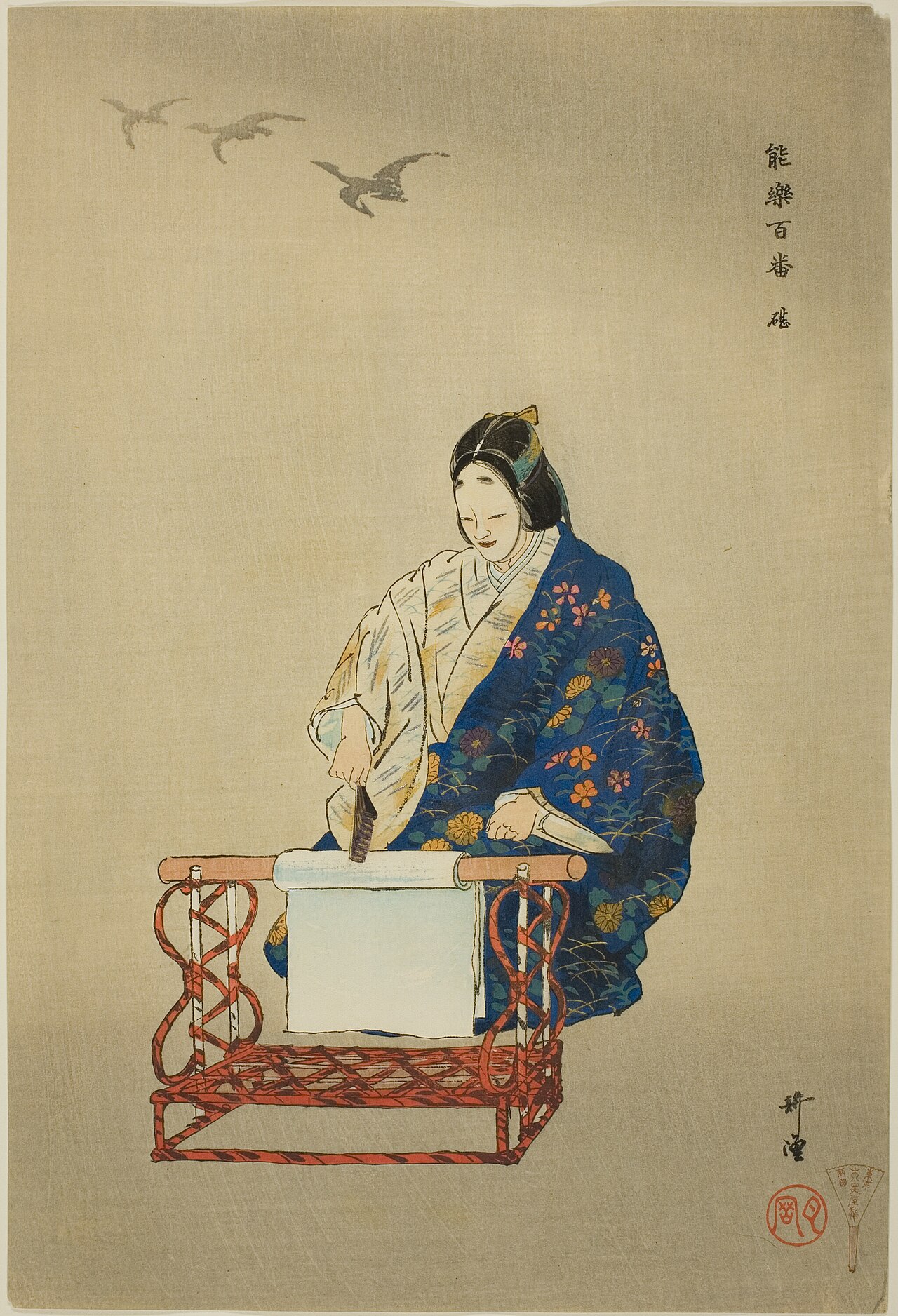
An ordinary tool becomes an address
Kinuta takes its name from a practical object. Kanjipedia, operated by the Japan Kanji Aptitude Testing Foundation, defines the character as a support used when beating cloth. The title therefore directs attention first to something worked by human hands. Before the audience encounters a ghost, it encounters the possibility that a repeated household action might carry feelings beyond its immediate task. [KIN1]
That possibility shapes this essay’s reading of the title. A tool normally promises an observable result: the person works on material close enough to touch. Communication with an absent person offers no equivalent certainty. Heard in this way, the repeated blows measure an uncomfortable distance between effort and response. Making a sound is something the wife can do; making someone answer is not. [KIN1] [KIN2]
Waiting is not an empty interval
Osaka University Library’s entry situates the wife in Ashiya while her husband has been in the capital for litigation for three years. It identifies her longing and resentment as central to the play and connects its title to the cloth-beating of the first part. The husband’s absence has a stated practical occasion, while the wife experiences its accumulated emotional cost. [KIN2]
Read from her side, waiting is activity with no secure finishing point. The calendar moves, but she cannot determine when the separation will end. This difference between passing time and receiving an answer is the pressure behind the object’s new purpose. A domestic sound becomes an attempted connection because the expected human connection has failed to provide reassurance. [KIN2]
A story makes sound seem possible
The Oshima Noh Theatre’s guide explains the wife’s remembered story of Su Wu: the sound of cloth-beating by his family reaches him far away in a dream. The guide also describes the attendant Yūgiri preparing the implement and joining her mistress. This is the play’s literary precedent for the wife’s hope, not evidence that sound can travel by supernatural means. [KIN3]
My reading emphasizes the difference between inheriting a story and obtaining its promised outcome. The wife has an example that makes her action imaginable, yet repeating the action cannot guarantee the same result. Yūgiri’s presence also makes the effort shared. One person’s longing becomes a scene of assistance, even though neither participant controls the distant listener. Their work has company; its intended destination remains uncertain. [KIN3]
Return arrives after the listener is lost
The Nohgaku Performers’ Association describes the husband returning after his wife’s death and seeking to comfort her spirit. She appears as a ghost whose suffering is made visible. The synopsis thus reverses the earlier direction of appeal: the person who was absent now addresses someone beyond ordinary reach. The return has occurred, but it cannot restore the relationship’s former conditions. [KIN4]
One interpretation of this reversal is that lateness becomes the play’s most disturbing distance. Geographical separation could have ended through travel; death makes the problem different. The ghost is a theatrical representation of suffering and attachment, rather than proof about an afterlife. Watching the exchange, we can ask what it means to become ready to listen only after another person can no longer be met in everyday life. [KIN4]
Sources and original texts
Original cultural readings of folklore, fiction and artistic representations. Interpretations are distinguished from source descriptions. Access to a collection record does not grant permission to reproduce its images or text. No supernatural event is verified.
- 砧 — 漢字一字 — Japan Kanji Aptitude Testing Foundation, Kanjipedia. Checked 2026-10-15.
- 砧 — 須田国太郎 能・狂言デッサン — Osaka University Library. Checked 2026-10-15.
- 鑑賞の手引き 砧 — Oshima Noh Theatre. Checked 2026-10-15.
- 砧(きぬた) — The Nohgaku Performers’ Association. Checked 2026-10-15.
Original English cultural analysis. Institutional source descriptions are paraphrased, and interpretive conclusions are identified as readings. No source prose is reproduced. One image (Tsukioka Kōgyo's Noh illustration of Kinuta) is reproduced from Wikimedia Commons in the public domain and credited with the image.