GIZUMO JAPANESE OCCULT · FOLKLORE & PERFORMANCE
Aoi no Ue: The Body That Never Enters
An empty garment and a formidable mask organize the unequal visibility of suffering in noh’s adaptation of The Tale of Genji.
Existing subject: Ghost stories · Narrative: fiction · Spoilers: plot-spoilers
Content note: Discussion of possession, jealousy, humiliation, illness, and violence against a woman within a traditional drama.
The Japanese noh play Aoi no Ue, with attention to its staging and adaptation of The Tale of Genji; possession is discussed as a literary device.
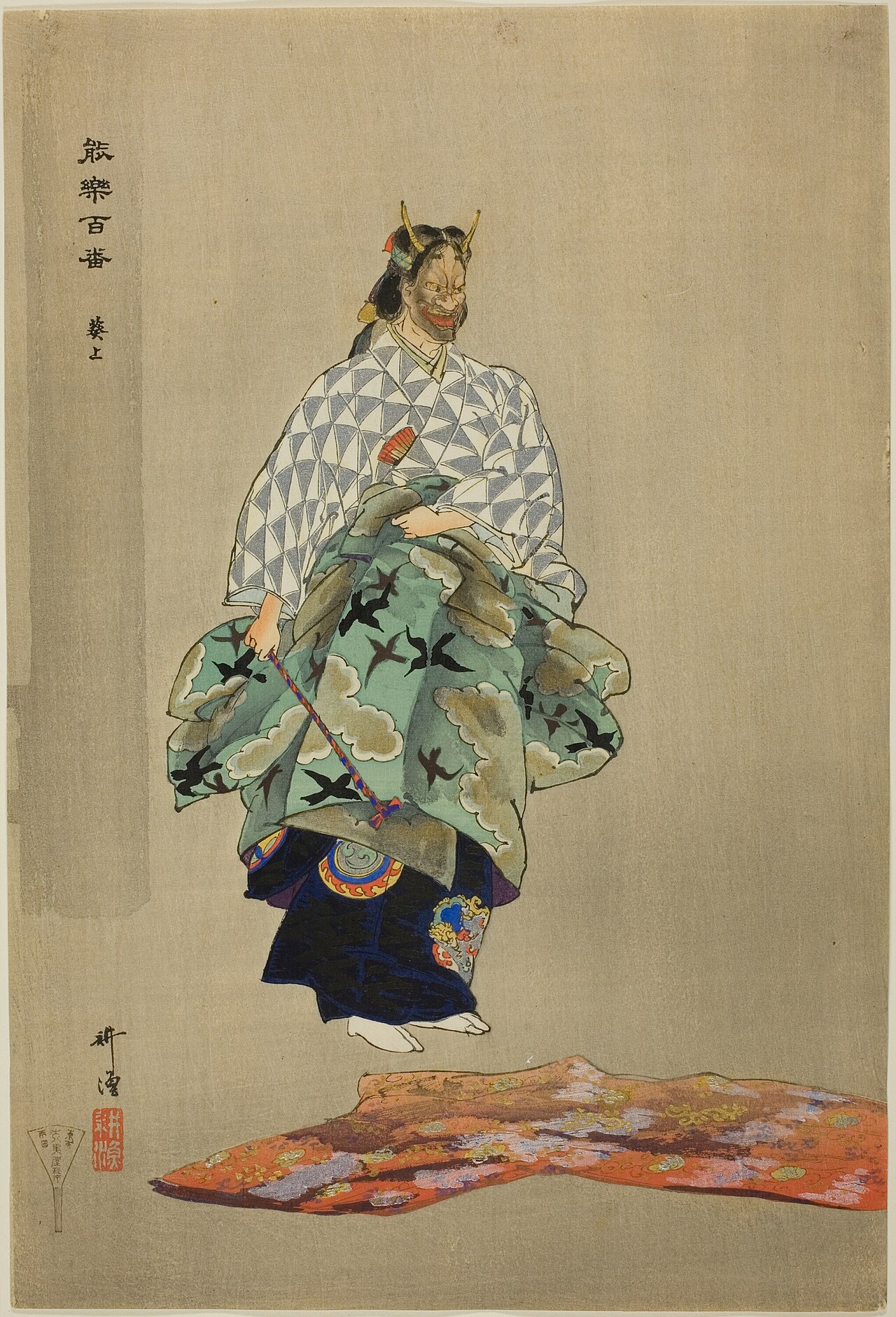
A person made present by clothing
Although Aoi no Ue bears Lady Aoi’s name, no actor plays her onstage. The Japan Arts Council explains that a kosode garment placed near the front of the stage represents her sickbed presence. This object also becomes a focus toward which other performers direct their actions. The arrangement gives the title character a visible location without supplying a speaking or moving body. [AU1]
In my reading, that absence makes attention itself a subject of the play. Viewers must keep remembering that cloth signifies a vulnerable person. When another performer turns toward it, the space between body and garment acquires dramatic pressure. A useful way to watch is to follow those changes of orientation. Who approaches the garment, who addresses it, and who appears to control the surrounding space? The smallest object can organize the largest imbalance of power. Its stillness is especially troubling beside the mobility granted to everyone else. [AU1]
A face containing more than fury
The spirit’s later appearance uses a hannya mask. In its costume guide, the Japan Arts Council describes the mask’s expression as holding jealousy, resentment, and sadness, with human feeling surviving within a frightening transformation. It identifies the white hannya used for this noblewoman’s role as a high-ranking form. These performance conventions complicate a quick identification of horns and fangs with uncomplicated evil. [AU2]
The interpretive challenge is to hold suffering and harmful action together. Recognizing the spirit’s sadness need not excuse what threatens Aoi. Equally, responding only to the terrifying face can flatten the emotional information the convention supplies. The mask offers no simple permission to choose one woman’s pain and disregard the other’s. Watching its relationship to the motionless garment, rather than isolating it as an exotic object, makes the conflict more demanding. One figure receives a fiercely expressive theatrical presence; the other has to be imagined through an object. [AU2]
Adaptation as a change of emphasis
The play draws on the Aoi chapter of The Tale of Genji, but the Japan Arts Council stresses that it creates a distinct dramatic world. Rokujō’s living spirit is central, and the adaptation adds a medium and a religious practitioner absent from that episode’s cast. The council also notes that chapter names and recurring carriage imagery evoke the novel without directly quoting its text. [AU3]
This is therefore a haunting by the living within the story, a distinction worth preserving when placing the work among ghost narratives. As a reading of the adaptation, the repeated carriage references make an earlier public humiliation persist inside the present sickroom. An event does not have to be staged literally to exert pressure on everything spectators see. Together, verbal recollection, a transformed face, and an unoccupied garment turn social injury into theatrical space. The result invites attention to how suffering becomes visible, and to whose suffering remains difficult to see. [AU3]
Sources and original texts
Original cultural readings of folklore, fiction and artistic representations. Interpretations are distinguished from source descriptions. Access to a collection record does not grant permission to reproduce its images or text. No supernatural event is verified.
- Aoi no Ue: The displayed kosode — Japan Arts Council, Cultural Digital Library. Checked 2026-10-15.
- Aoi no Ue: Costume of the later shite — Japan Arts Council, Cultural Digital Library. Checked 2026-10-15.
- Aoi no Ue and The Tale of Genji — Japan Arts Council, Cultural Digital Library. Checked 2026-10-15.
Original English cultural analysis. Institutional source descriptions are paraphrased, and interpretive conclusions are identified as readings. No source prose is reproduced. One image (Tsukioka Kōgyo's Noh illustration of Aoi no Ue) is reproduced from Wikimedia Commons in the public domain and credited with the image.