GIZUMO JAPANESE OCCULT · FOLKLORE & PERFORMANCE
Azukiarai: Listening for an Unseen Worker
The sound of washing beans becomes a way to explore how regional stories give unfamiliar noises a task, a voice, or a body.
Existing subject: Yōkai · Narrative: folklore · Spoilers: premise-only
Content note: Unsettling nighttime sounds and a local account of people avoiding a washing place; supernatural beliefs treated as folklore.
Selected azukiarai accounts from Ehime and Nagano, compared with Mizuki Shigeru Museum’s presentation; no claim of exhaustive distribution or a single origin.
Work audible in the dark
What makes a familiar sound strange is sometimes the missing worker. The Mizuki Shigeru Museum describes azukiarai as a nighttime noise beside a mountain stream or beneath a bridge, resembling beans being washed while no figure can be seen. Its account gives the repeated sound a written rhythm, shoki-shoki. The listener is offered an activity without a visible person performing it. [AZU1]
One interpretation begins with that ordinary task. A wholly unfamiliar noise might remain meaningless; washing beans supplies a recognizable pattern of movement and repetition. The unsettling element is the gap between recognizing the work and locating its worker. In this presentation, azukiarai does not need a spectacular body because the listener’s effort to complete the scene already supplies the drama. [AZU1]
A rhythm almost becomes speech
An Ehime record summarized by Nichibun locates the sound beneath a bridge on rainy nights. Its wording suggests someone naming a measure of grain before a rubbing rhythm, shāri-shari. The database identifies a 1978 folklore publication referring to the Shigenobu town history. This is one documented local account, rather than a standard song that every azukiarai was said to sing. [AZU2]
Read closely, the noise sits between work and language. A repeated scrape becomes something a listener can almost answer, as if a hidden person were keeping count. This reading does not explain what physically produced the sound. It describes the account’s imaginative movement: resemblance becomes rhythm, rhythm approaches speech, and an otherwise empty place begins to seem occupied by intention. [AZU2]
An explanation inside the tradition
A different Nichibun summary, drawn from a university survey of Ogawa village in Nagano published in 1961, places the nighttime sound in a small water channel called a zenge. It identifies the supposed bean-washing noise with a weasel’s cry. The animal explanation belongs to the recorded account itself; the database entry is not a modern acoustic investigation proving the cause. [AZU3]
This detail complicates any simple opposition between folklore and explanation. The record can preserve the memorable name while offering an animal source for what people hear. My interpretation is that naming and explaining need not erase each other. Azukiarai can organize the description of an experience even when its teller also supplies an ordinary creature as the explanation behind it. [AZU3]
When the worker acquires a face
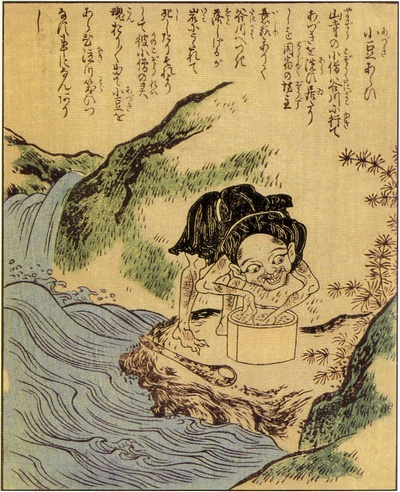
Not every selected account keeps the worker invisible. A Matsuyama story summarized from a 1974 local-study publication describes a middle-aged woman washing beans and rice in a basin at a washing place. The narrative places this in the early Meiji period and says people subsequently avoided doing laundry there for about five years. These are claims within the recorded story, not independently verified events. [AZU4]
The basin and shared washing place bring the unsettling activity close to everyday communal labor. In this reading, a visible figure does not necessarily resolve unease; it can make an ordinary place difficult to use. Across these accounts, the strongest continuity is less a fixed appearance than a question raised by worklike sound: who is there, and how should others respond? [AZU4]
Sources and original texts
Original cultural readings of folklore, fiction and artistic representations. Interpretations are distinguished from source descriptions. Access to a collection record does not grant permission to reproduce its images or text. No supernatural event is verified.
- 水木マンガの世界: 33. 小豆洗い — Mizuki Shigeru Museum. Checked 2026-10-15.
- 小豆洗い, record 0200280 — International Research Center for Japanese Studies (Nichibun). Checked 2026-10-15.
- 小豆洗い・イタチ, record 2360677 — International Research Center for Japanese Studies (Nichibun). Checked 2026-10-15.
- 小豆洗い, record 0080252 — International Research Center for Japanese Studies (Nichibun). Checked 2026-10-15.
Original English cultural analysis. Institutional source descriptions are paraphrased, and interpretive conclusions are identified as readings. No source prose is reproduced. One image (Takehara Shunsen's azukiarai) is reproduced from Wikimedia Commons in the public domain and credited with the image.