GIZUMO JAPANESE OCCULT · FOLKLORE & PERFORMANCE
Dōjōji: The Bell That Will Not Keep the Past Outside
A reading of the noh drama Dōjōji through its forbidden ceremony, suspended bell, and difficult musical breathing.
Existing subject: Ghost stories · Narrative: folklore · Spoilers: plot-spoilers
Content note: Legendary violence, gender-based exclusion, destructive jealousy, and a woman represented as a serpent.
The specific Japanese noh play Dōjōji, set at Dōjōji in Kii; theatrical interpretation rather than evidence of supernatural events.
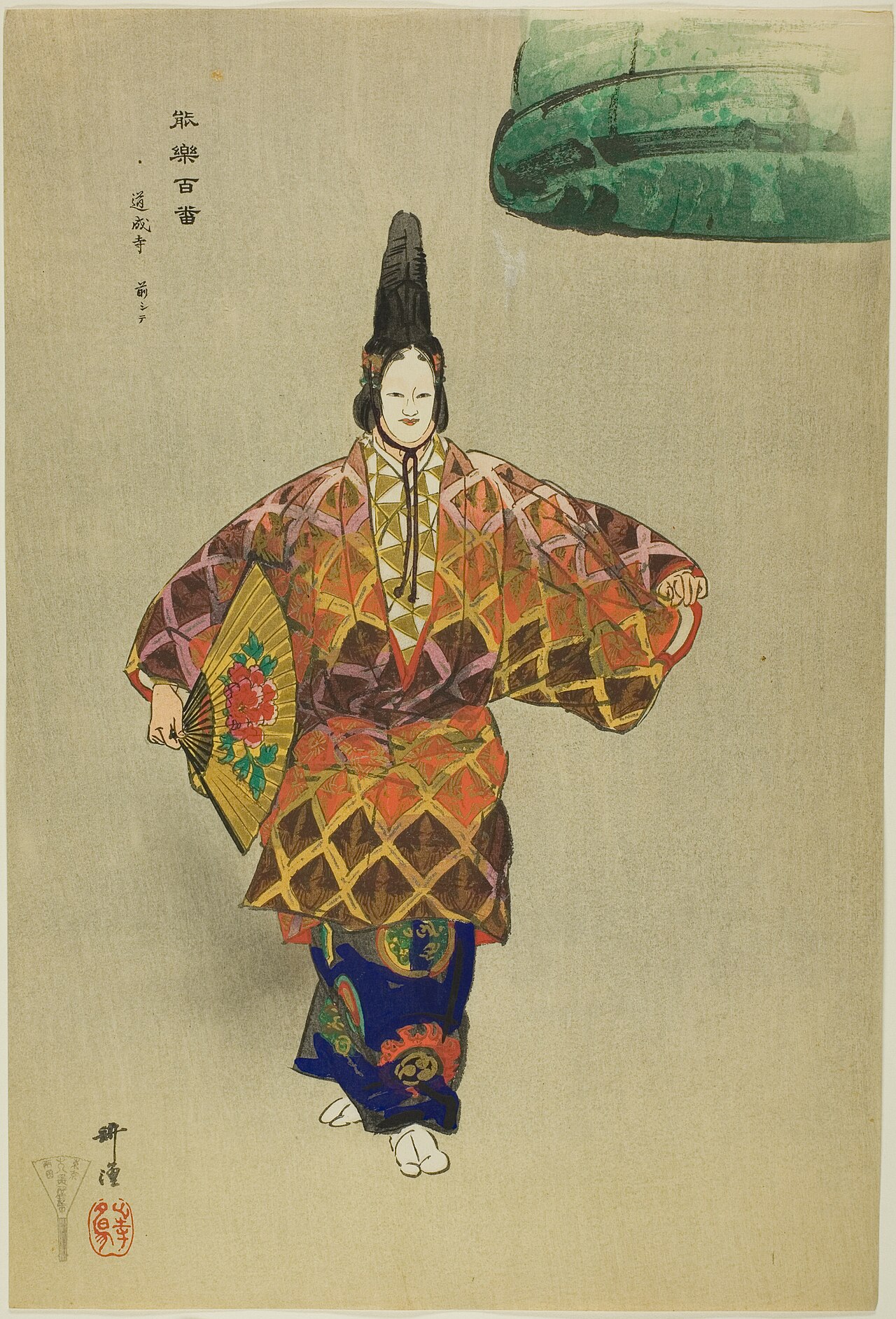
A ceremony with a boundary
The noh play Dōjōji begins with an attempt to regulate a sacred occasion. At a ceremony for a new temple bell, the resident priest orders that women be excluded. A shirabyōshi dancer nevertheless gains admission by offering a performance. Her dance leads toward the bell, which falls around her. Later, the priests raise it to reveal a serpent figure. This is a theatrical haunting rooted in a particular temple story, rather than an account of an observed supernatural occurrence. [DJ1]
One way to read that opening is as a failure of administrative certainty. The ceremony has rules, attendants, and a stated purpose, yet its organizers cannot decide what memories will enter with their guest. A prohibition regulates access without resolving the history that makes access frightening. On this reading, the bell becomes a boundary whose apparent solidity is deceptive: it can conceal a body, but it cannot settle the meaning of that body's return. [DJ1]
The object that receives attention
The Nohgaku Performers' Association identifies Dōjōji with exceptionally large stage machinery and intense tension. Its brief description joins the dancer's entry into the bell to her emergence in serpent form, while identifying love and jealousy as central concerns. That combination makes the object more than background decoration. The same bell belongs to the ceremony, interrupts it, and becomes the site through which the disturbing figure is revealed. [DJ2]
For a contemporary viewer, the effect can be understood as a redistribution of attention. We look toward a person, then toward the place where that person has disappeared. Absence acquires a shape. My interpretation is that the bell makes concealment active: while it blocks sight, it concentrates expectation. The frightening question is no longer simply who the visitor is. It becomes what the assembled community will discover when its own ceremonial object is opened to view again. A familiar object has become difficult to look at without imagining what it contains. [DJ2]
Listening before the revelation
Sound offers another route into this drama. The Broadcast Library's catalogue for an NHK educational programme records performer Konparu Yasuaki discussing the difficulty of coordinating breathing with the small drum during ranbyōshi. That documented emphasis is useful preparation: the dance asks for attention to a relationship between performers, not just anticipation of the bell sequence. The catalogue establishes the subject of the programme; it does not substitute for watching a complete performance. [DJ3]
This suggests a listening exercise rather than a fixed explanation. Notice when you begin to expect another movement or sound, and how strongly you depend on the performers to satisfy that expectation. In my reading, such waiting makes the audience bodily susceptible to the drama. Suspense can emerge through sustained attention before any monstrous form appears. The story's supernatural transformation and the performers' ordinary, demanding coordination occupy the same event, allowing crafted timing to carry an extraordinary imagined presence. [DJ3]
Sources and original texts
Original cultural readings of folklore, fiction and artistic representations. Interpretations are distinguished from source descriptions. Access to a collection record does not grant permission to reproduce its images or text. No supernatural event is verified.
- Dōjōji — Noh and Zeami — Japan Arts Council. Checked 2026-10-15.
- Dōjōji — The Nohgaku Performers’ Association. Checked 2026-10-15.
- Japanese Traditional Performing Arts: Introduction to Noh 6, Dōjōji, Episode 2: Noh Music — Broadcast Programming Center of Japan. Checked 2026-10-15.
Original English cultural analysis. Institutional source descriptions are paraphrased, and interpretive conclusions are identified as readings. No source prose is reproduced. One image (Tsukioka Kōgyo's Noh illustration of Dōjōji) is reproduced from Wikimedia Commons in the public domain and credited with the image.