GIZUMO JAPANESE OCCULT · FOLKLORE & PERFORMANCE
Okiku: What the Missing Plate Changes
Okiku’s plates change meaning between versions.
Existing subject: Ghost stories · Narrative: folklore · Spoilers: plot-spoilers
Content note: Fictional coercion and killing.
Folklore and fiction; no supernatural verification.
A count that cannot finish
In Hyōgo Prefectural Museum of History’s Banshū Sarayashiki retelling, Danshirō hides one of a set of ten plates to put Okiku under suspicion after she rejects him. He subsequently kills her. Her ghost’s counting reaches nine, accompanied by the noise of dishes. The missing item is a trap set by another character, not proof that she failed at her work. [OK1]
The museum explains its textual route: its simplified account follows Himejijōshi, which summarizes Banshū Sarayashiki jitsuroku. Naming that version keeps the interpretation grounded. Here the unfinished count can be read as a wrong that cannot be settled by recounting the same objects. The audience knows why ten will never arrive. Repetition exposes the accusation’s cruelty rather than solving the invented shortage. [OK1]
When counting acquires a body
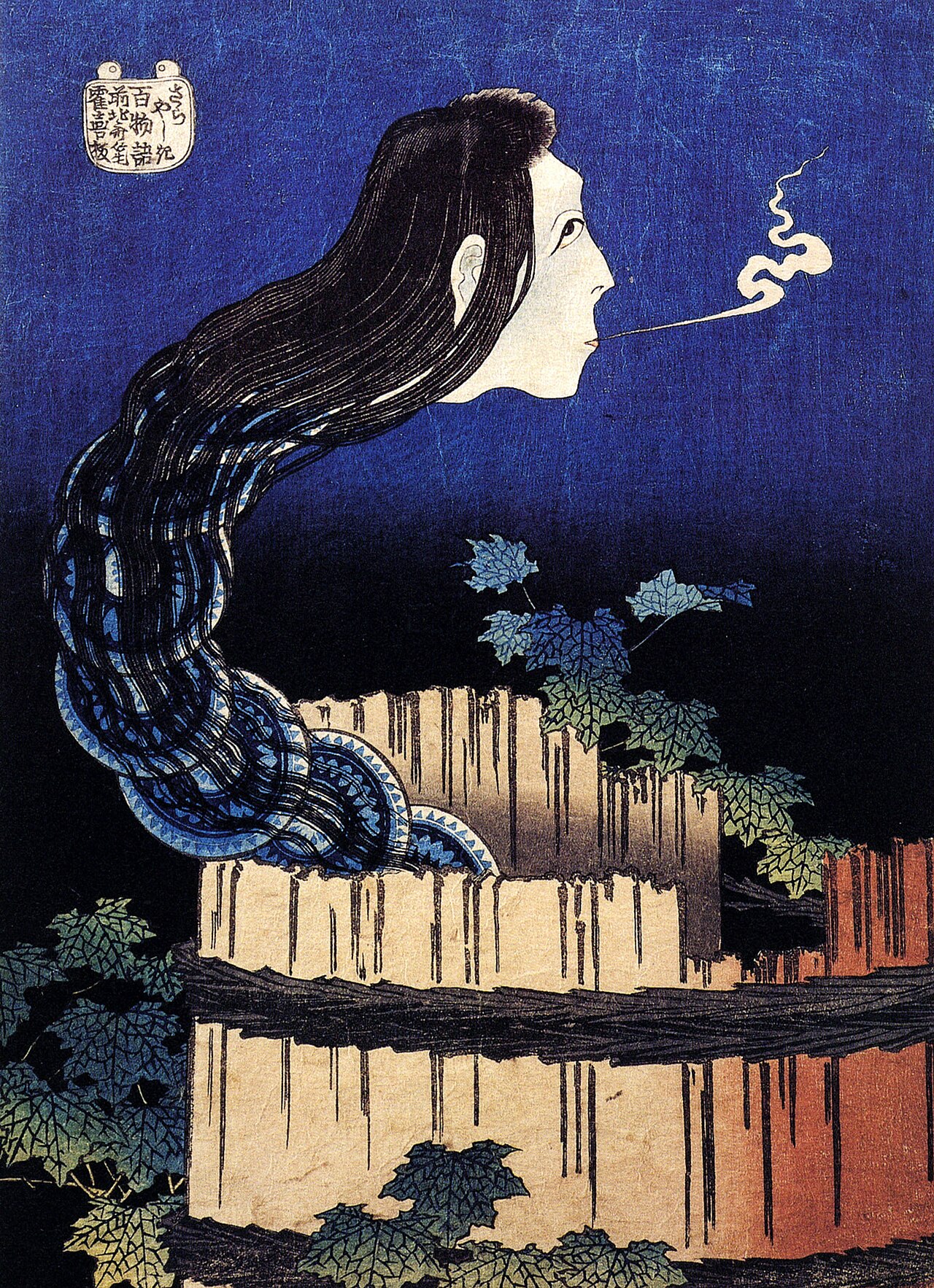
The Smithsonian’s National Museum of Asian Art gives a different emphasis in its label for Hokusai’s Sarayashiki, dated 1831–1832. Its story summary says Okiku’s master threw her into a well because she broke his favourite dish. The label describes a woman’s head above a winding neck made of stacked plates, and associates the well with counting and the sound of breaking porcelain. [OK2]
Keep that broken-dish account distinct from the hidden-plate plot. The picture nevertheless offers a striking way to understand repetition: dishes become the structure carrying Okiku’s face. Our reading is that the object implicated in her death can no longer be put aside as household equipment. It has become inseparable from the apparition. Counting is given a visible form, without the image having to reproduce a spoken sequence. The household object takes on a bodily presence. [OK2]
A broken plate tests affection
Okamoto Kidō’s Banchō Sarayashiki, first performed in 1916, changes the plate’s purpose. The Japan Arts Council explains that Okiku deliberately breaks an heirloom to test Aoyama Harima’s love. Discovering that she doubted him, he kills her. The dramatic question has shifted from an imposed shortage to a destructive test within a relationship. It is important to name Kidō’s play: its motives differ. [OK3]
The variation is part of the subject
Himeji Literature Museum’s 2018 Sarayashiki exhibition describes traditions extending beyond both Himeji and Edo, with a servant’s death associated variously with losing or breaking a treasured plate. Its range includes Edo-period narrative writing and Kyōgoku Natsuhiko’s novel Kazoezu no Ido, alongside pictures and performance. The museum presents a continuing field of reworking, rather than one synopsis that resolves every appearance of Okiku. [OK4]
That variety makes the plate a useful question to carry from version to version. Who causes its absence or damage? Who is permitted to accuse, and whose explanation counts? These are questions for comparing the stories, not assertions that they all answer alike. A familiar ghost’s name can remain while the distribution of blame changes. Asking what happens to the plate helps make those changes audible before the counting begins. A change in the object’s fate can change the ethical question. [OK4]
Official sources
Original cultural interpretation of folklore, fiction and artistic representations. Source access does not grant image or text republication rights. No supernatural event is verified.
- 播州皿屋敷 — Hyōgo Prefectural Museum of History. Checked 2026-10-15.
- Sarayashiki (The House of Broken Plates) — Smithsonian National Museum of Asian Art. Checked 2026-10-15.
- 番町皿屋敷 — Japan Arts Council. Checked 2026-10-15.
- 怪談皿屋敷のナゾ — Himeji Literature Museum. Checked 2026-10-15.