GIZUMO JAPANESE OCCULT · FOLKLORE & PERFORMANCE
Oiwa: The Face a Lantern Cannot Hide
Oiwa’s lantern image connects a named ghost with a celebrated actor.
Existing subject: Ghost stories · Narrative: fiction · Spoilers: plot-spoilers
Content note: Fictional poisoning, disfigurement and death.
Folklore and fiction; no supernatural verification.
A face changes the scene
In Tōkaidō Yotsuya Kaidan, poison alters Oiwa’s face before she returns as a ghost. The Japan Arts Council describes her hair-combing scene and the later effect that brings her out of a burning lantern. These transformations make recognition part of the drama: the familiar woman persists through an altered appearance and an unexpected entrance. How does an audience identify Oiwa when her visible form keeps changing? [GO1]
A lantern keeps her name
Japan Museum SieboldHuis holds Kunisada’s 1831 print of Onoe Kikugorō as the lantern ghost. The catalogue identifies the play as Tōkaidō Yotsuya kaidan and the venue as Edo’s Ichimura theatre. The lantern’s inscription names Oiwa and celebrates the production’s success. The pictured apparition therefore carries two kinds of recognition: a character recognizable within the story, and a performer recognizable to a theatre audience. [GO2]
The surviving sheet is only half of a diptych; the museum identifies the missing partner as Seki Sanjūrō II playing Kamiya Niemon. That absent counterpart matters to our reading. A lantern-face encountered alone can seem a self-contained monster. In a theatrical pairing it belongs to an encounter between named roles. Oiwa’s appearance is directed at somebody, while also displaying the attraction of a celebrated performance. [GO2]
A face without a full body
The Spencer Museum of Art describes Gekkō’s hanging scroll Oiwa as a figure dissolving into darkness, her form obscured by long, disordered hair. Its interpretation connects the painting with the stage apparition emerging from a lantern. The emphasis falls on partial visibility: the ghost need not present a fully outlined body in order for a viewer to meet her face. [GO3]
Read that obscurity as an active part of the image’s unease. Darkness makes the limits of the figure uncertain, while the named face gives the apparition a particular identity. The painting holds those two conditions together. Oiwa can be difficult to locate bodily and impossible to dismiss personally. This is our interpretation of the museum’s description, not a claim that the scroll records the exact lighting or movements of one performance. [GO3]
The object becomes the face
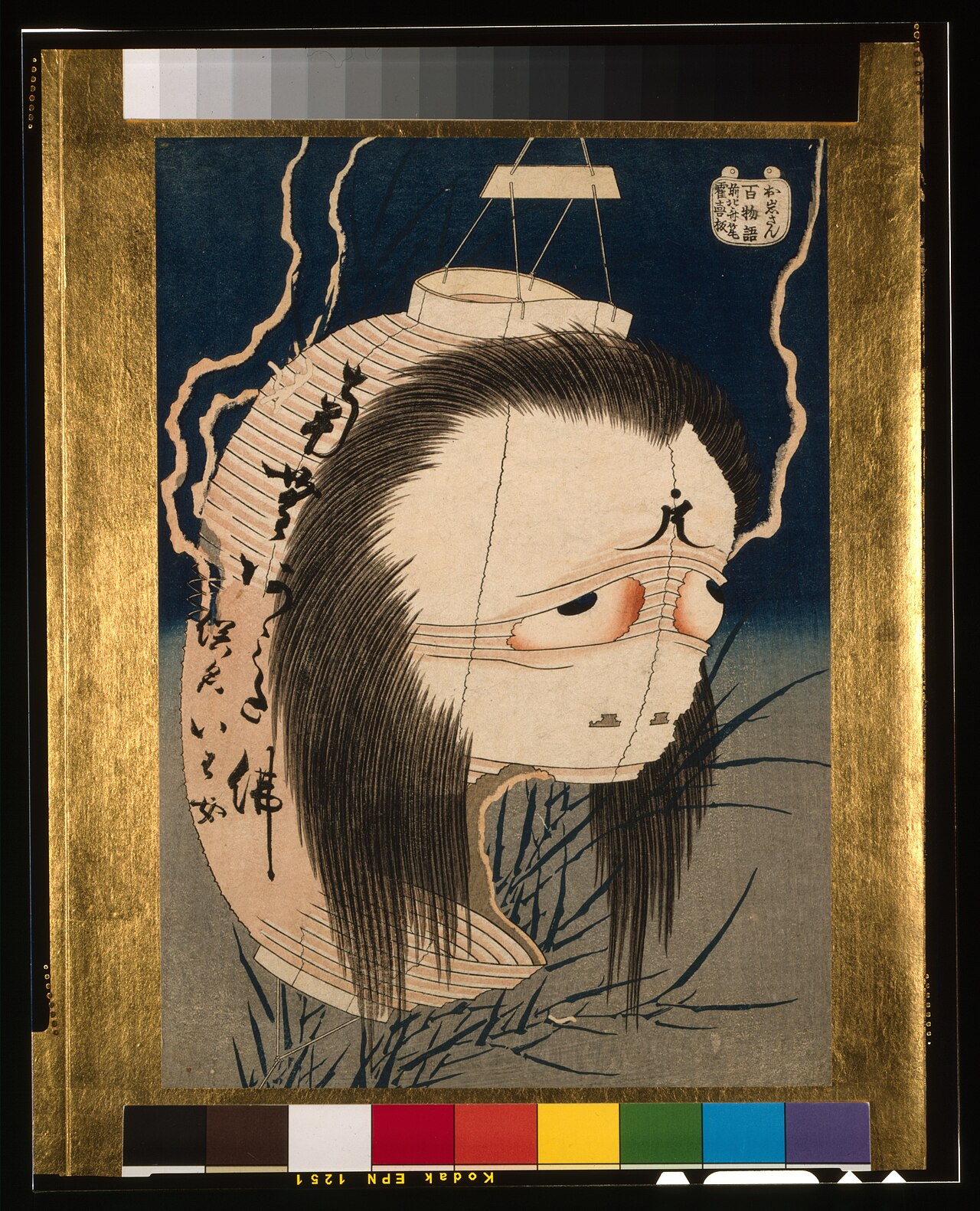
The Rijksmuseum describes Hokusai’s O-Iwa lantern print through a few material details: a smoking paper lantern, holes and a ghostly face, with reeds against grey and dark blue. The combination makes an ordinary object carry the features of a person. Rather than placing a separate ghost beside a lamp, the design lets the lamp itself become the place where she is recognized. [GO4]
That fusion gives the lantern a double role in our reading. It remains something made from paper, with an enclosure that can be damaged, yet it also looks back as Oiwa. Recognition does not wait for a complete human shape. The unsettling encounter begins when an object’s openings become features and the viewer can no longer keep the woman and the lantern comfortably apart. [GO4]
Official sources
Original cultural interpretation of folklore, fiction and artistic representations. Source access does not grant image or text republication rights. No supernatural event is verified.
- 東海道四谷怪談 — Japan Arts Council. Checked 2026-10-15.
- Onoe Kikugorō as the Lantern Ghost — Japan Museum SieboldHuis. Checked 2026-10-15.
- Oiwa (The Lantern Ghost) — Spencer Museum of Art. Checked 2026-10-15.
- O-Iwa het lantaarn spook — Rijksmuseum. Checked 2026-10-15.