GIZUMO JAPANESE OCCULT · FOLKLORE & PERFORMANCE
The Nue: A Strange Voice, More Than One Body
Composite anatomy and shifts of viewpoint change how the nue is encountered in stories and pictures.
Existing subject: Yōkai · Narrative: folklore · Spoilers: plot-spoilers
Content note: A fictional monster’s attack and defeat are discussed; no supernatural event is verified.
Folklore and fiction; no supernatural verification.
The description is not a fixed species
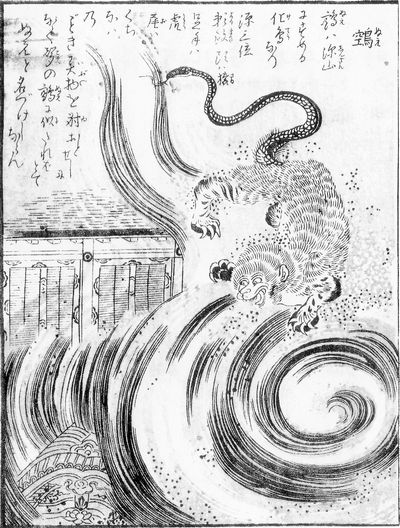
What does a nue look like? The National Archives of Japan supplies an unusually revealing comparison. Its Yorimasaki account describes a creature with a monkey’s shape, a tanuki’s face, a fox’s tail, a snake’s belly and a cat’s feet. Its voice resembles the bird called nue, identified in the exhibition as the toratsugumi. An illustrated Heike monogatari instead gives the monster a monkey’s head, tanuki’s torso, snake’s tail and tiger’s limbs. These are descriptions within stories, not zoological observations. Before correcting an unfamiliar image to match a remembered monster, identify its textual version. Even this one institutional comparison produces two distinct combinations rather than a single anatomical checklist. [NU1]
Making the creature dominate the picture
The Printing Museum’s account of Kuniyoshi’s Kyoto design, dated 1852, shifts the question from anatomy to attention. The huge creature fills the image, while the archer Yorimasa appears small at the lower right. The museum emphasizes this decision to foreground the mysterious beast rather than the heroic warrior. It also notes differences between the dark cloud and the night sky. In this particular composition, discovering the hero takes a second look. The visual hierarchy therefore need not match the tale’s celebration of his achievement. Ask whose presence you notice first, then compare that first impression with the action the accompanying account assigns to each figure. [NU2]
The defeat has two human participants
A nineteenth-century inrō in Montreal Museum of Fine Arts separates the human roles across its faces. The museum identifies Yorimasa on the back and his retainer Ino Hayata Tadazumi killing the nue on the front. Its narrative explanation distinguishes the archer’s shot from the retainer’s subsequent sword attack. For this object, naming every armed figure Yorimasa would erase part of the story. A useful description pairs a name with an action and a location on the object. If an online view shows only one face, consult the catalogue’s account of the other before deciding which episode or participant the whole object celebrates. [NU3]
When the defeated creature becomes the speaker
Fukuoka City Museum identifies another redistribution of attention in the Noh play Nue. In the Heike narrative, the episode contributes to Yorimasa’s record of heroic achievement. The play makes the defeated creature its protagonist and gives expression to an inner darkness that the original account leaves unexplored. That change goes beyond supplying a different costume or body. It changes whose experience receives attention after the encounter. Read the play’s perspective as a dramatic interpretation; it does not reveal an independently documented testimony from a creature. The same defeat can support a hero’s reputation in one telling and the vanquished being’s suffering in another. [NU4]
For a comparison, keep voice, body, action and viewpoint in separate notes. A changed body is one kind of variation; moving the observer’s attention or giving another character the central voice is another. Neither requires you to decide which image depicts a real animal.
Official sources
Original cultural interpretation of folklore, fiction and artistic representations. Source access does not grant image or text republication rights. No supernatural event is verified.
- 源氏挙兵の背後に… — National Archives of Japan. Checked 2026-10-15.
- 京都 鵺 大尾 — Printing Museum. Checked 2026-10-15.
- Five-case Seal Caddy — Montreal Museum of Fine Arts. Checked 2026-10-15.
- 能面の世界4 — Fukuoka City Museum. Checked 2026-10-15.