GIZUMO JAPANESE OCCULT · FOLKLORE & PERFORMANCE
Why Does Kuzunoha Hold a Brush in Her Mouth?
A brush, a child and a farewell message concentrate the fox mother’s departure into a single gesture.
Existing subject: Yōkai · Narrative: folklore · Spoilers: plot-spoilers
Content note: Separation of a mother and child; plot details from folklore and theatrical adaptations.
Folklore and fiction; no supernatural verification.
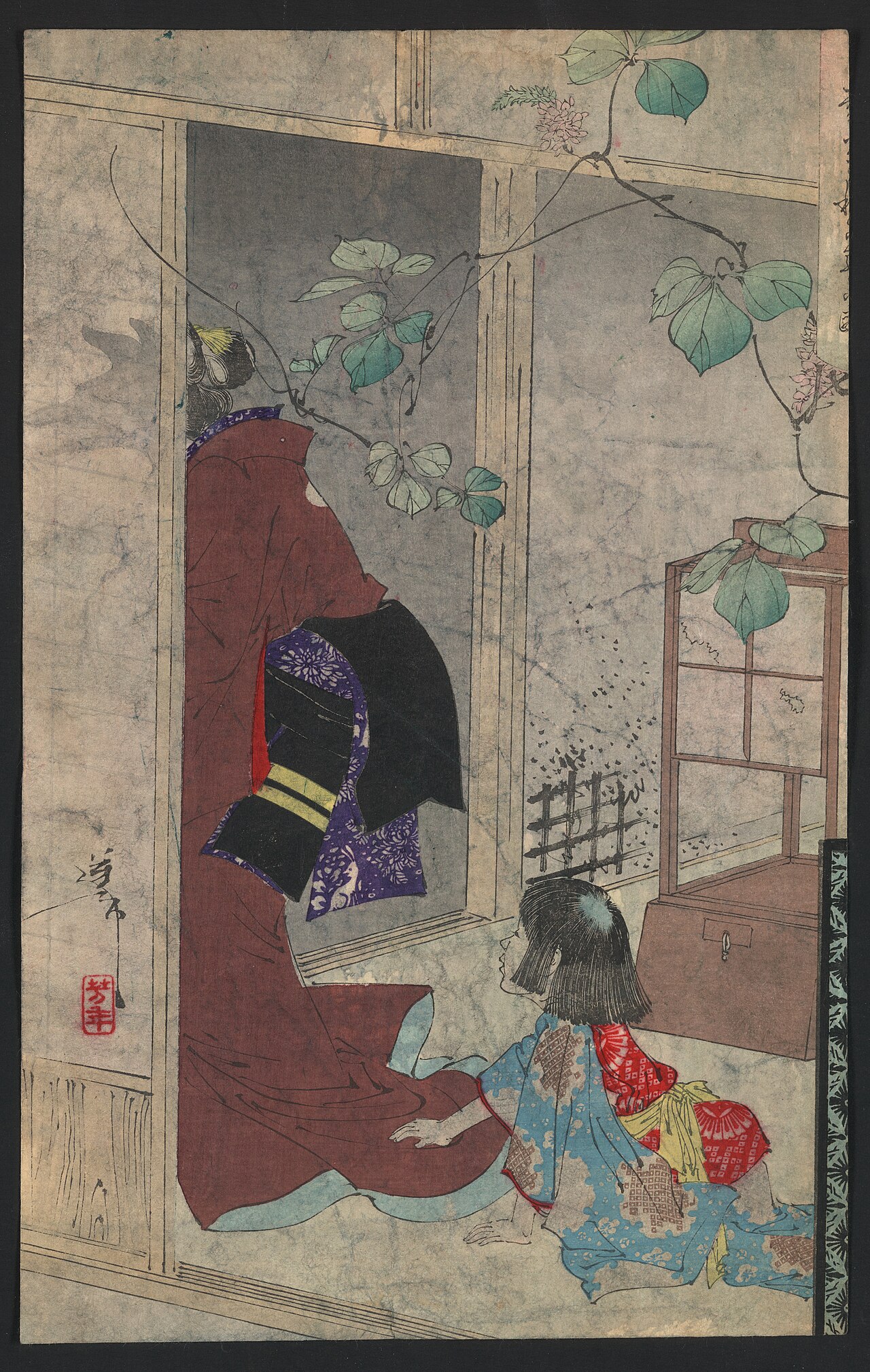
Start with the relationship
The unusual brush is easier to understand through a farewell than through a general list of fox powers. Japan Arts Council places Kuzunoha within stories of marriage between humans and other beings. In the version it summarizes, a rescued fox becomes Yasuna’s wife and bears a son; discovery of her fox identity leads to departure. The Council’s accompanying illustration emphasizes a child clinging to the departing mother. That is the relationship to keep in view when comparing other Kuzunoha images. The crucial question is what each representation lets the mother do for her child at the moment they must separate, rather than simply how it exposes an animal disguise. [KZ1]
Arms and mouth perform different tasks
The Metropolitan Museum’s wooden netsuke makes the combination explicit: a fox holds a baby while carrying a writing brush in her mouth. Its description identifies the subject as Kuzunoha writing her farewell poem after her identity has been discovered. The brush is therefore a narrative clue, not an unexplained accessory. Holding the child and making a message occupy the same small figure. One way to read that arrangement is as two competing needs held together: bodily care continues even as words prepare for absence. This is an interpretation of the described composition, not a reconstruction of how an actual person wrote or how every theatrical production staged the scene. [KZ2]
Add the person who watches
A separate Met library essay describes the departure in an actor-print diptych from Azuma nishiki-e. Kuzunoha holds her son while writing on a shōji with the brush between her teeth; Yasuna observes her. The essay identifies Kawarazaki Gonjūrō I in the role. This adds a witness and a surface for the message to the simultaneous actions. In describing this print, keep three identities distinct: the mother within the fiction, the actor representing her and the husband within the scene. Calling it simply a picture of a fox loses the family encounter; treating it as an unmediated record of that encounter loses its theatrical framing. [KZ3]
The message can carry the departure
Noda City Museum describes the same parting scene in an oshie lamp. Its inset window stands for the shōji and carries Kuzunoha’s farewell verse. A fox form appears on that screen, which the museum reads with tenderness. Here the message and the revealed animal form share a surface within the object. Look for the written farewell even when your first attention goes to the figure: it connects the scene with the person who will be absent. The museum’s account supports this particular arrangement, rather than a rule that every image of Kuzunoha must include the same props or the same stage action. [KZ4]
Try describing one example without beginning with the word transformation. Name who holds whom, who writes, who watches and where the message remains. Then add what reveals the fox identity. This order makes the family’s separation legible before the supernatural premise takes over your description.
Official sources
Original cultural interpretation of folklore, fiction and artistic representations. Source access does not grant image or text republication rights. No supernatural event is verified.
- 狐女房と親子の情愛 — Japan Arts Council. Checked 2026-10-15.
- Kuzunoha Netsuke, 10.211.2046 — Metropolitan Museum. Checked 2026-10-15.
- Japanese Theater and Textiles — Metropolitan Museum. Checked 2026-10-15.
- 尾上菊五郎の葛の葉 — Noda City Museum. Checked 2026-10-15.