GIZUMO JAPANESE OCCULT · FOLKLORE & PERFORMANCE
Botan Dōrō: Can a Printed Page Keep a Voice?
Enchō’s printed ghost story carries a spoken manner into the history of modern Japanese prose.
Existing subject: Ghost stories · Narrative: fiction · Spoilers: premise-only
Content note: Mentions a ghostly visitor and death; does not reveal the story’s outcome.
Folklore and fiction; no supernatural verification.
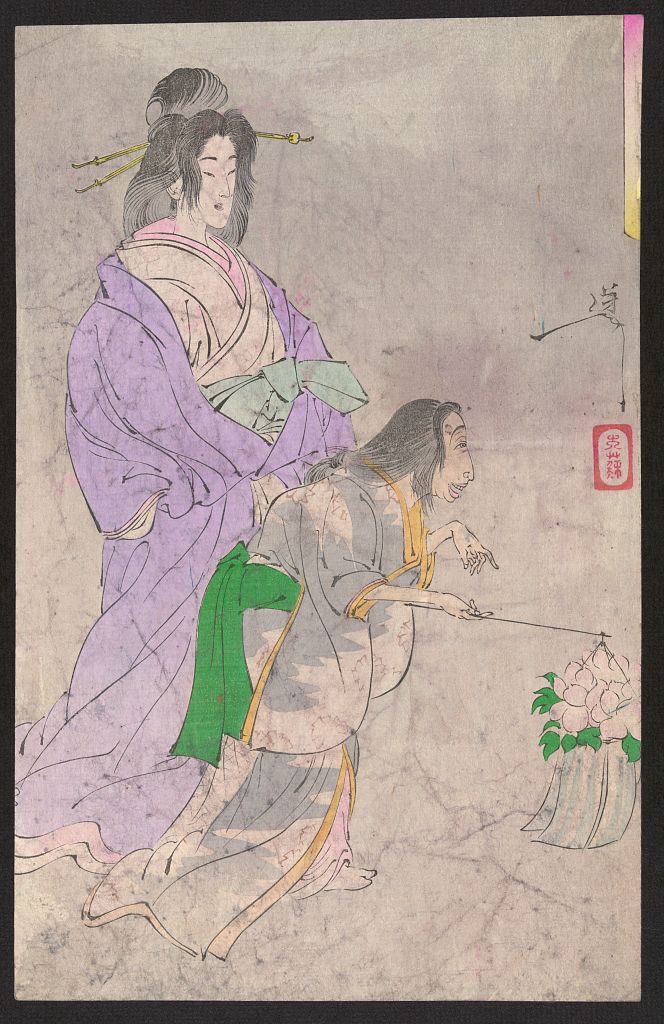
Two names behind one telling
The National Institute of Japanese Literature dates Sanyūtei Enchō’s creation of Botan Dōrō to 1861–1864 and identifies an 1884 shorthand-based publication. Its catalogue distinguishes Enchō, who narrated, from Wakabayashi Kanzō, who recorded. Those paired credits matter. The printed story reaches us through a speaking performer and somebody working to turn that speech into writing. [BD1]
Publication is therefore one event in the work’s life, rather than a date that explains every encounter with it. When reading this version, imagine two connected activities: a narrator shaping a tale for listeners, and a recorder making words available to absent readers. This distinction opens a more precise question than whether the book preserves the plot: what does it preserve of the telling? [BD1]
The footsteps need a listener
Tsurumi University Library introduces Otsuyu’s ghost through the sound of wooden footwear approaching at night. Its Enchō exhibition also recounts how Wakabayashi and Sakai Shōzō attended performances over fifteen days, with the telling issued in weekly instalments. Sound and serial expectation both belong to this account of Botan Dōrō: an arrival within the story, and an audience waiting for another portion of it. [BD2]
On the page, approaching footsteps can still organize suspense. A reader supplies the interval between hearing an arrival and understanding it. That is our reading, not a reconstruction of Enchō’s voice. The library acknowledges the limits of transcription while valuing the recorders’ work; preserving words need not preserve every pause, emphasis or change in pace. [BD2]
The performer shapes the language
The National Diet Library’s Enchō biography describes a performer skilled in theatrical storytelling with props and in improvising a tale from three subjects offered by his audience. It also credits his shorthand books, including Botan Dōrō, with influencing Meiji writing that brought written language closer to speech. His importance extends beyond supplying a sequence of frightening events. [BD3]
That context suggests a useful way to read: attend to how narration addresses an imagined listener, not only to what happens next. The historical influence of a spoken manner does not make printed language an audio recording. Nor does a performer’s capacity for improvisation prove that every surviving sentence was improvised. Enchō’s craft and the book’s language remain connected without becoming interchangeable. [BD3]
Theatre gives the tale other bodies
Tokyo Metropolitan Library identifies the July 1892 Kabukiza production as Botan Dōrō’s first large-theatre staging. It notes that Onoe Kikugorō V performed three roles. Its associated actor print depicts the Iijima household scene, naming several characters and performers. This is already a different arrangement from one storyteller’s voice presenting the narrative: roles can be embodied by actors and related through a visible stage scene. [BD4]
Our comparison is about that change in arrangement, not a claim to have watched the production. Reading the transcript and encountering a theatrical representation invite different kinds of attention. One asks the reader to supply a speaking presence; the other gives that presence particular bodies. Neither encounter can stand in for all the ways this story has been told. [BD4]
Official sources
Original cultural interpretation of folklore, fiction and artistic representations. Source access does not grant image or text republication rights. No supernatural event is verified.
- 怪談 牡丹燈籠 — National Institute of Japanese Literature. Checked 2026-10-15.
- 明治の話芸―三遊亭円朝と速記本― — Tsurumi University Library. Checked 2026-10-15.
- 三遊亭円朝(初代) — National Diet Library. Checked 2026-10-15.
- 怪談牡丹燈篭 — Tokyo Metropolitan Library. Checked 2026-10-15.